flowchart TB
  E1["<b>Symbolic and early neural era</b> (1943 to 1969)<br/>1943 McCulloch-Pitts artificial neuron<br/>1956 Dartmouth workshop names the field<br/>1958 Rosenblatt perceptron; McCarthy's Lisp<br/>1969 Minsky-Papert critique of perceptrons"]
  E2["<b>Winters and statistical learning</b> (1970 to 2011)<br/>1984 CART decision trees<br/>1986 Backpropagation popularised<br/>1995 Support vector machines"]
  E3["<b>Deep learning era</b> (2012 to 2016)<br/>2012 AlexNet halves the ImageNet error rate<br/>2015 Deep-learning review in Nature"]
  E4["<b>Transformer and scaling era</b> (2017 to 2021)<br/>2017 Attention Is All You Need<br/>2018 GPT-1 and BERT establish pre-training<br/>2019 GPT-2; 2020 GPT-3 and scaling laws"]
  E5["<b>Reasoning and agentic era</b> (2022 to 2026)<br/>2022 InstructGPT, ChatGPT, chain-of-thought<br/>2023 GPT-4 and Llama 2 open weights<br/>2024 o1-style reasoning models<br/>2025 open-weight reasoning near the frontier<br/>2026 GPT-5.6, Gemini 3.5, Claude Fable 5"]
  E1 --> E2 --> E3 --> E4 --> E5
1 A Brief History of Generative AI: How We Got Here
We can only see a short distance ahead, but we can see plenty there that needs to be done.
Alan M. Turing, Computing Machinery and Intelligence (1950)
1.1 Learning objectives
By the end of this chapter you should be able to:
- Trace the principal intellectual lineages that produced contemporary generative AI: symbolic computation, statistical learning, and connectionist models.
- Name the half-dozen technical milestones, from the perceptron to the transformer, that gate today’s large language models.
- Articulate why generative AI is not magic: the underlying machinery is pattern-matching learned from data, not reasoning in the human sense.
- Identify which contemporary capabilities are consequences of scale and which reflect a genuine algorithmic advance.
1.2 Orientation
The capabilities that students and clinicians encounter under the banner of generative AI in 2026 sit on top of roughly seventy years of work in computing, statistics, and the cognitive sciences. None of the underlying ideas appeared in 2022 with ChatGPT. The transformer architecture was published in 2017. Backpropagation, which makes today’s networks trainable, was popularized in 1986. The first artificial neuron model was published in 1943. The recursion-and-symbolic-expression style of programming that anchored early artificial-intelligence research was published in 1958.
Figure 1.1 arranges these milestones, and the ones this chapter treats in detail, into five eras. We suggest returning to the figure as each section adds its node to the chain; the point to take from it now is that the interval between a conceptual milestone and its practical consequence is measured in decades, not years, and that the apparent suddenness of 2022 is an artifact of where the public happened to be looking.
This chapter sketches the path from those origins to the systems the rest of the book uses. The aim is not historical completeness; the aim is demystification. A clinical or public-health researcher who understands that a large language model is a very large, very carefully trained statistical pattern-matcher will read its output differently from one who treats it as an oracle. The former will look for the kinds of failures statistical pattern-matchers exhibit (correlation without causation, extrapolation outside the training distribution, confident interpolation between half-remembered examples) and will design verification accordingly. The latter will trust the fluency and be surprised by the failures.
The chapter is also a useful reference frame for the rest of the book. Subsequent chapters treat generative AI as a tool to be selected, prompted, and verified. Naming the parts of the tool, what is novel, what is borrowed, what is scaled up rather than fundamentally new, makes the selection and verification decisions sharper.
1.3 The researcher’s contribution
History is not a substitute for technique, but it disciplines technique. Three judgments that thread through the chapter and the rest of the book have historical anchors worth naming.
(Judgment 1.) Distinguishing scale from novelty. Many of the capabilities that appear most striking in 2026 language models, fluent prose, in-context arithmetic, the ability to draft a regression specification, are emergent consequences of scale rather than new algorithmic ideas. The next-token prediction that underlies GPT-style models is technically continuous with n-gram language modeling from the 1980s. What changed is the size of the model, the size of the training corpus, and the architecture’s ability to exploit both. The researcher’s contribution is to see through the gloss and recognize that scale alone does not solve problems the underlying statistical machinery cannot solve.
(Judgment 2.) Recognizing the inductive-bias choices behind every model. Each milestone in this chapter embodies a choice about what kinds of structure the model is permitted to learn easily. CART makes axis- aligned splits; convolutional networks impose translational equivariance; transformers impose a permutation-invariant treatment of tokens combined with learnable attention weights. The biases shape what the model finds. A clinical or public-health researcher who deploys a model without thinking about its inductive biases is implicitly trusting a choice someone else made.
(Judgment 3.) Reading the literature in its arc, not its surface. A 2024 paper that claims a new technique is often a refinement of an idea from the 1990s. A 2026 benchmark that appears to demonstrate near-human performance often rests on training-set leakage that echoes a critique made of perceptron evaluation in 1969. Reading new claims with the historical arc in mind makes the discount factor on hype calibrated rather than skeptical or credulous.
1.4 From symbols to functions: the Lisp era
The phrase artificial intelligence enters the literature at the 1956 Dartmouth workshop organized by McCarthy, Minsky, Rochester, and Shannon. The optimism of the period (researchers expected human-level AI within a generation) shaped both the theoretical agenda and the programming languages built to pursue it.
McCarthy’s Lisp (McCarthy, 1960) is the foundational artifact of this era. Lisp is a functional language in which programs and data share a single representation, the symbolic expression or s-expression. A function in Lisp is a list; a list of lists is a tree; a tree of trees is a program transformation. The language was designed for an era in which artificial intelligence was understood as symbolic manipulation: reasoning about the world by transforming logical expressions, much as a mathematician transforms an equation.
The symbolic paradigm produced real successes (theorem provers, expert systems, planning programs) and a generation of researchers comfortable with treating intelligence and symbol manipulation as substitutable. It also produced two structural limitations that the rest of this chapter is, in part, a response to. First, encoding any but the simplest world into logical expressions turned out to be brutally labor-intensive; the knowledge engineering bottleneck of the 1980s expert-system era was the practical face of this. Second, real-world data are noisy and ambiguous in ways logical inference handles poorly. The symbolic tradition was not wrong; it was incomplete.
For contemporary practice the relevant inheritance from this era is conceptual. The notion that a program is something one writes (procedural code that computes a result step by step) versus something one trains (parameters fitted to data) splits along a line whose modern form is the symbolic-versus-statistical divide. Contemporary generative AI is overwhelmingly on the statistical side, but the symbolic tradition lives on in tool-use, agent planning, and the structured-output techniques of Chapter 8.
1.5 Pattern recognition by fitting: CART and the rise of nonparametric methods
In parallel with the symbolic-AI tradition, statisticians were developing methods that learned patterns directly from data without requiring a parametric model specified in advance. The line of work that this chapter treats as exemplary is the Classification and Regression Trees (CART) framework of Breiman, Friedman, Olshen, and Stone (Breiman et al., 1984).
CART builds a piecewise-constant prediction surface by recursively partitioning the predictor space. At each step the algorithm picks the variable and split point that most reduces a loss (Gini impurity for classification, residual sum of squares for regression), applies the split, and recurses on each side. The result is a tree whose leaves are constant predictions and whose interior nodes are simple yes-or-no decisions on a single covariate.
The technique mattered intellectually for two reasons. First, it offered a method for automatic feature discovery: the splits produced by CART encoded interactions and nonlinearities that a parametric researcher would have had to anticipate and code by hand. Second, the CART formalism made plain that prediction performance and interpretability were on a tradeoff curve: deep trees fit better but were less interpretable; shallow trees were more legible but weaker predictors. The same tradeoff structures every subsequent debate in the field, from random-forest versus single-tree to deep network versus logistic regression.
CART itself was extended into random forests (Breiman, 2001) and gradient-boosted trees (Friedman, 2001), which became, and remain, the default applied-statistical-learning toolkit for tabular data. For the clinical or public-health researcher the relevant modern descendant is xgboost and its relatives, still the dominant choice for risk-score modeling and electronic-health-record outcome prediction.
1.6 The neural network arc: perceptron, winter, deep learning
The parallel and eventually dominant tradition is connectionism, the study of networks of simple computing units inspired loosely by neurons. The arc has three phases: an early optimism that produced the first trainable networks; a long dormant period (the AI winter) when theoretical limits and computational costs killed funding; and a 2010s revival that produced the deep learning boom from which modern generative AI is descended.
The early period. McCulloch and Pitts (McCulloch & Pitts, 1943) proposed a mathematical model of the neuron in which inputs are weighted, summed, and passed through a threshold. The construction is striking because it shows that any logical function can be represented as a network of such neurons; the model is Turing-complete in the relevant sense.
Rosenblatt’s perceptron (Rosenblatt, 1958) gave the first trainable network: starting from random weights, the perceptron updates its weights based on classification errors and converges, on linearly separable data, to a correct classifier. Rosenblatt was optimistic about the implications. Minsky and Papert’s Perceptrons (Minsky & Papert, 1969) was the technical critique that ended the early-optimism phase: they demonstrated that single-layer perceptrons could not solve problems requiring nonlinear decision boundaries (famously, the XOR problem). Multi-layer perceptrons could in principle, but no one knew how to train them.
The first winter. The community that took the critique seriously turned to symbolic AI; the community that did not was small enough to be marginal. Funding dried up. The unsolved problem was credit assignment in deep networks: when a deep network makes an error, which weights deserve which share of the blame?
The backpropagation revival. The credit-assignment problem was solved (or rather, a sufficiently practical solution was found) in the 1980s. Rumelhart, Hinton, and Williams (Rumelhart et al., 1986) popularized backpropagation: a careful application of the chain rule of calculus that propagates the error gradient backwards through the network and apportions blame across all weights. The technique had been independently discovered several times before, but this paper was the one that the field absorbed.
Backpropagation made multi-layer networks trainable in principle. Two practical obstacles delayed its impact by roughly twenty years. First, vanishing gradients: in deep networks with the activations of the era, the gradient signal tended to attenuate exponentially as it propagated backwards, leaving early-layer weights effectively untrained. Second, compute and data: the networks that worked were small, and training them on 1990s hardware was painfully slow.
The deep-learning boom. The 2010s saw both obstacles fall. New activation functions (notably the rectified linear unit, ReLU) attenuated the vanishing-gradient problem. New normalization techniques and architectural choices stabilized training. Most consequentially, GPUs made the matrix multiplications that dominate neural- network training tractable at scales that had previously been infeasible. The AlexNet result of Krizhevsky, Sutskever, and Hinton (Krizhevsky et al., 2012) on the ImageNet image-classification benchmark is the moment the field marks as the start of the modern era. Deep convolutional networks, trained on a million images across a thousand categories, halved the error rate of the previous best methods. The result was so decisive that the entire computer-vision community pivoted within two years.
The deep-learning era introduced an architectural vocabulary that subsequent generative AI inherits: convolutional layers for translational structure; recurrent layers for sequence structure; embeddings that map discrete inputs (words, tokens) to dense real-valued vectors. The 2015 LeCun, Bengio, and Hinton Nature review (LeCun et al., 2015) summarizes the state of play at the inflection point.
1.7 Statistical learning theory: the kernel detour
Between the 1969 perceptron critique and the 2012 ImageNet result, the dominant style of machine learning was not connectionist but statistical-learning. The work of Vapnik and colleagues on support vector machines (Cortes & Vapnik, 1995) and the broader kernel methods literature defined the field. Support vector machines solved the nonlinear-decision-boundary problem that killed perceptrons by mapping data into a high- dimensional space where the boundary became linear, without ever explicitly computing the high-dimensional representation, the kernel trick.
For the clinical and public-health researcher the practical inheritance from this era is the Elements of Statistical Learning (Hastie et al., 2009) textbook synthesis: a unified statistical view of supervised learning that treats trees, kernels, ensembles, and splines as alternative answers to a common question. The same book is the bridge to the modern era; its authors are the principal exponents of the statistical- learning view that contemporary generative AI is best read against.
The kernel era also clarified an idea that recurs in modern neural-network practice: a network’s capacity to generalize is governed by the interaction of model complexity, training-set size, and the implicit or explicit regularization applied during training. The classical bias-variance decomposition is the theoretical home of this idea; modern neural networks appear to violate the classical decomposition in suggestive ways (the double descent phenomenon (Belkin et al., 2019)) but the underlying statistical intuition remains load-bearing.
1.8 The transformer breakthrough
The architectural step that separates 2017-and-later generative AI from what came before is the transformer, introduced by Vaswani and colleagues at Google in Attention is All You Need (Vaswani et al., 2017). The paper’s contribution is to show that, for sequence processing, a class of layers called attention can replace the recurrent and convolutional structures that had previously dominated. The full title is the contribution: prior work used attention as a supplement to recurrence; the paper argued that attention alone, applied at every layer and across all positions, was sufficient and in fact preferable.
Three properties of the transformer matter for the contemporary picture.
Parallelism. Recurrent networks process a sequence position by position; attention processes all positions in parallel. The implication is that transformer training scales to corpora and model sizes that recurrent training cannot reach in any reasonable budget. This single property explains a great deal of why scaling worked.
Scaling behavior. The transformer’s parameter count and training-data appetite scale together, and the relationship between them and model performance turns out to follow approximately predictable scaling laws (Hoffmann et al., 2022; Kaplan et al., 2020). Performance on broad capability benchmarks improved smoothly as parameters, data, and compute were jointly scaled. This predictability was the basis for the multi-billion- dollar bets that produced GPT-3, GPT-4, and their descendants.
Emergence. Specific capabilities (in-context learning, multi-step reasoning, code generation) appear relatively suddenly at certain scales rather than improving smoothly. The phenomenon is contested, some of the apparent emergence is artifact of how capabilities are evaluated (Schaeffer et al., 2023), but it is part of the lived experience of building models in this era and shapes the field’s expectations.
The transformer was not novel as an idea; attention had been studied for some years. What was novel was the combination of attention-as-the-only-mechanism with the hardware (GPUs and later specialized tensor processors) and the scale of training data (most of the high- quality text on the open internet) that the major labs by then had access to.
A point worth pinning down is that the 2017 transformer is the architectural milestone, not the endpoint of architecture research. Post-2017 work on attention has been substantial. Multi-head attention gave way to grouped-query attention (Llama 3, Qwen3), multi-head latent attention (DeepSeek V2 onwards), sliding-window attention (Gemma 3), DeepSeek sparse attention (V3.2 onwards), and gated and hybrid stacks that mix transformer-like attention with state-space models in the Mamba family (Qwen3-Next, Kimi K2.5, GLM-5) (Raschka, 2026b). Frontier 2026 open-weight models routinely replace most full- attention layers with cheaper linear-time variants. Yet the user-facing experience is largely the same. The architecture matters, but the researcher should be careful not to over-attribute capability gains to it: ‘Modeling performance is likely not attributed to the architecture design itself but rather the dataset quality and training recipes’ (Raschka, 2026a).
1.9 From transformer to large language model
The path from a 2017 architecture to the chat models the rest of this book uses runs through three additional ideas, each of which is conceptually accessible.
Pre-training. Rather than training a model end-to- end on a specific task (sentiment classification, question answering), the modern recipe is to pre-train the model on a large corpus with a generic objective, typically next-token prediction, and then adapt it. Devlin and colleagues’ BERT (Devlin et al., 2019) and Radford and colleagues’ GPT-1 and GPT-2 (Radford et al., 2018; Radford et al., 2019) established the recipe. The pre-training step does most of the work; the adaptation step is comparatively cheap.
Scale. GPT-3 (Brown et al., 2020) demonstrated that scaling the same recipe by an order of magnitude in parameters and data produced qualitatively new capabilities. In-context learning, the ability to solve a task by showing the model a few examples in the prompt rather than retraining it, was the most striking of these. The contemporary applied user encounters this as prompting: the prompt is, in effect, a brief adaptation step that costs nothing to run.
The scale claim is easier to feel than to state. Figure 1.2 plots approximate parameter counts for a handful of milestone models on a logarithmic axis; each labeled gridline is a factor of a thousand. The climb from the perceptron’s hundreds of adjustable weights to the trillion-parameter frontier spans roughly nine orders of magnitude, and most of it occurred after 2012. Clearly, no comparable growth occurred in the underlying learning principle, which remains gradient descent on a prediction loss; what grew was the machinery.
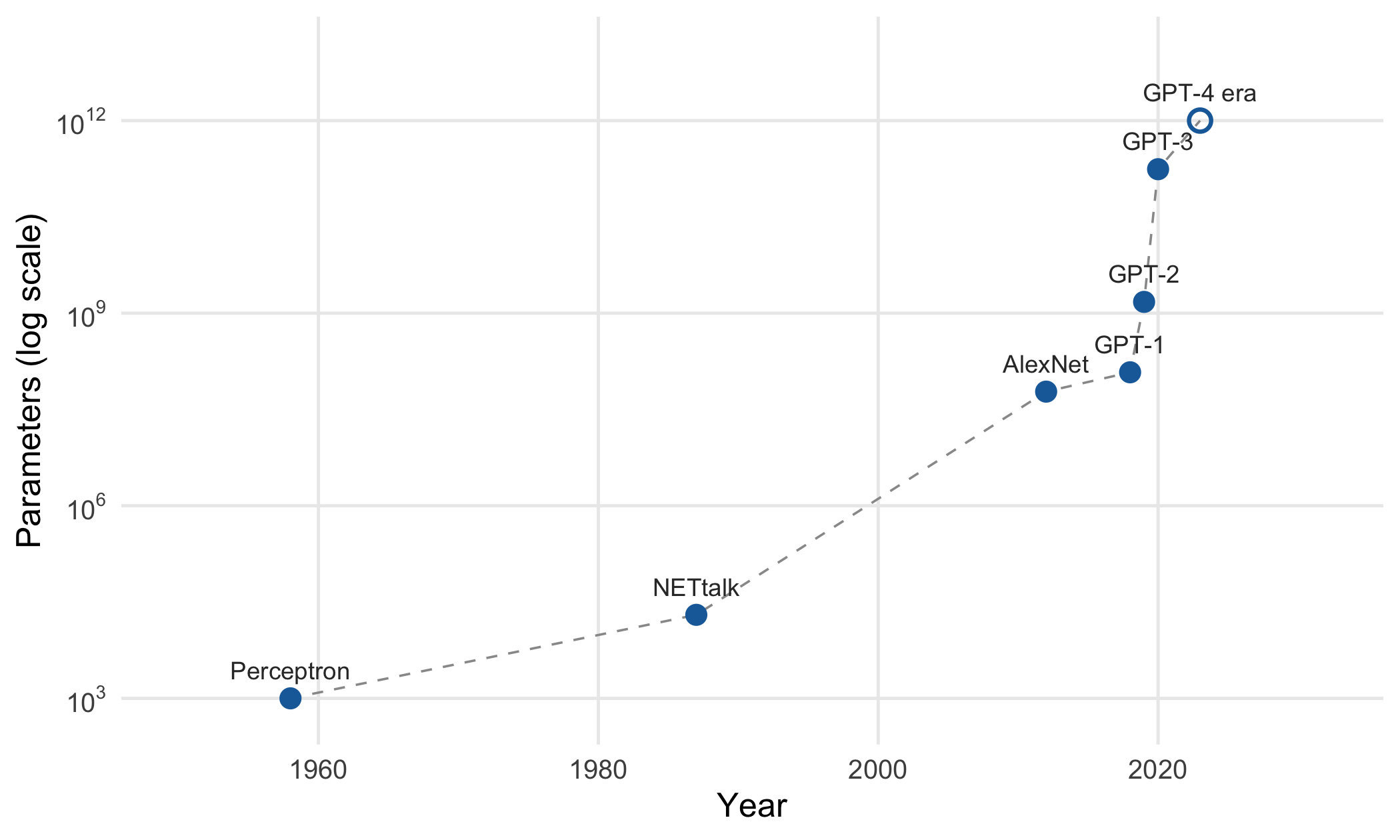
Alignment. A model trained to predict the next token on the open internet will produce text continuous with the training distribution, which includes much that is unhelpful, untruthful, or unsafe. The post-training steps that turn a raw pre-trained model into a useful assistant, supervised fine-tuning and reinforcement learning from human feedback (Ouyang et al., 2022), are the alignment recipe. Later variants substitute, for part of the human labeling, feedback generated by a model working from an explicit written set of principles (Bai et al., 2022). The InstructGPT and ChatGPT releases of late 2022 are the public manifestation. The foundation model framing of Bommasani and colleagues (Bommasani et al., 2021) names the resulting class of artifacts.
Reasoning and openness. Two further developments complete the arc to 2026. First, chain-of-thought prompting showed that asking a model to produce intermediate steps before its answer improves accuracy on multi-step problems, in the few-shot setting (Wei et al., 2022) and, strikingly, with nothing more than the instruction to think step by step (Kojima et al., 2022). The o1 family of 2024 internalised the idea, training models to produce extended reasoning traces before responding (OpenAI, 2024), and open-weight reasoning models followed within months (DeepSeek-AI et al., 2025). Second, the GPT-4 generation (OpenAI, 2023) set the closed frontier while Llama 2 (Touvron et al., 2023) and its successors established a parallel open-weight lineage. By mid-2026 the era is best described as reasoning and agentic: the frontier releases of the first half of the year (OpenAI’s GPT-5.6 family, Google’s Gemini 3.5, Anthropic’s Claude Fable 5) compete largely on reasoning depth and tool use rather than on raw scale, and the open and closed lineages are, for many applied tasks, difficult to tell apart.
The contemporary chat model the reader interacts with is, mechanically, a transformer; trained at scale on internet text with next-token prediction; then aligned on demonstrations and feedback to behave as an assistant. Reasoning models add a step in which the model is trained to produce extended chains of thought before responding; agentic models add infrastructure for tool use and multi-step action; multimodal models share weights across text, image, audio, and structured- document tokens. The capabilities of Chapter 2 are specializations and combinations of this base recipe.
Table 1.1 consolidates the chapter to this point. The final column is the one we ask the reader to attend to: every era is defined as much by what its systems could not yet do as by what they could, and it would be imprudent to assume the current era is an exception.
| Era | Dates | Defining idea | Representative system | What it could not yet do |
|---|---|---|---|---|
| Early connectionism | 1943-1969 | networks of simple threshold units, trained from errors | Rosenblatt’s perceptron | learn nonlinear boundaries; train more than one layer |
| Symbolic AI | 1956-1980s | intelligence as symbol manipulation over hand-coded rules | Lisp theorem provers; MYCIN | learn from data; tolerate noise and ambiguity |
| Statistical learning | 1984-2011 | flexible functions fitted to data, with complexity controlled | CART, random forests, SVMs | learn representations from raw text or pixels |
| Deep learning | 2012-2016 | representations learned end to end on GPU hardware | AlexNet | model long-range sequence structure at scale |
| Transformer and scaling | 2017-2021 | attention as the only mechanism; predictable gains from joint scaling | GPT-3 | follow instructions; behave as a reliable assistant |
| Reasoning and agentic | 2022-2026 | post-training on feedback; extended chains of thought; tool use | ChatGPT; o1-style reasoning models; the mid-2026 frontier | verify its own factual claims; the burden of verification stays with the user |
1.10 The view from public health
But what does a seventy-year genealogy of pattern-matchers have to do with population health? A fair amount, it turns out, and the pattern of contact between the two fields is itself instructive: each era touched public health exactly where its defining idea was strong and failed exactly where that idea was incomplete.
The symbolic era’s flagship medical system was MYCIN, a 1970s Stanford expert system that recommended antimicrobial therapy for bacteraemia and meningitis from roughly 600 hand-written rules. In formal evaluation its recommendations compared respectably with those of infectious-disease faculty, yet it was never used on a patient. The knowledge base was costly to build and to keep current, and the questions of integration and responsibility had no workable answers. The knowledge-engineering bottleneck was, in an infectious-disease clinic, not an abstraction.
The statistical-learning era, by contrast, entered epidemiology quietly and stayed. Classification trees and their ensemble descendants became routine tools for risk stratification, outcome prediction, and variable selection in observational cohorts, largely because their inductive biases (axis-aligned splits on a modest number of covariates) suit tabular epidemiological data well.
The scaling era supplies the cautionary tale. Google Flu Trends estimated influenza activity from search-query volumes; it tracked CDC surveillance closely at launch and then drifted badly, at its worst overestimating peak influenza activity by roughly a factor of two (Lazer et al., 2014). The failure was not computational. It was statistical: the data-generating process was non-stationary (search behavior changed, partly because the search interface changed), and the model was maintained apart from the surveillance system it was meant to serve. We note the parallel deliberately, since the pattern-matching machinery of this chapter, scaled to language, inherits exactly this class of failure, and the verification discipline of the later chapters is the response.
1.11 What this means for your work: not magic
The historical arc above licenses three claims that the rest of this book treats as background.
Generative AI is statistical pattern matching. The underlying mechanism is conditional probability over tokens, learned from data. It is not reasoning in the human sense; it is not access to a knowledge base; it is not consultation with experts. The fluency that appears reasoning-like is the consequence of training data that contains reasoning-like text. This claim is strong, but it is also the established technical consensus in the field; the contested question is whether that statistical pattern matching, at scale, is sufficient for the tasks the field claims it solves.
Verification is non-optional. Statistical pattern-matchers fail in characteristic ways: extrapolation outside the training distribution, confident hallucination of plausible-but-false facts, sensitivity to surface features of the prompt that have no semantic content. Each of these failure modes has a direct historical antecedent; they are not surprises. Every chapter of this book treats verification as a design property because the failure modes are predictable and the stakes in clinical and public- health work are real.
Capability gains are mostly scale. Many of the between-version capability jumps that the field has seen since 2020 are scale gains rather than algorithmic gains. This matters for the researcher because it implies that capabilities a model lacks today may appear in the next-version model with no architectural change. The flip side is that capabilities a model demonstrates on a benchmark may not generalize to the researcher’s specific task; benchmark gains are not user-task gains. The discipline is to evaluate on the researcher’s task rather than on the field’s benchmarks.
The genealogy presented here, symbolic computation, statistical learning, connectionism, transformers, large language models, is one compression of a much longer history. The reader who wants the full version should consult Russell and Norvig (Russell & Norvig, 2021) or the more historically focused Mitchell account (Mitchell, 2019). The reader who wants the mathematical interior should work through Goodfellow, Bengio, and Courville (Goodfellow et al., 2016) alongside Bishop (Bishop & Bishop, 2024). The reader who wants to do applied work, the reader of this book, can take from this chapter the framing that follows: a powerful statistical pattern-matcher trained on a great deal of data is a useful collaborator and an unreliable oracle. The rest of the book is about treating it as the former.
1.12 Worked example: tracing one prediction
A useful exercise for building intuition is to trace, informally, what happens when a transformer-based chat model receives the prompt:
In a randomized controlled trial, the primary outcome was reduction in HbA1c at 12 weeks. What baseline covariates would you adjust for?
The model does not consult a database of trial-design principles. It does not call a function to look up HbA1c. The mechanical sequence is roughly as follows.
- Tokenization. The prompt is split into tokens, integer indices into a vocabulary of around 50,000 tokens depending on the model. HbA1c may become one token or three.
- Embedding. Each token is mapped to a learned vector, typically around 4,000 dimensions for a contemporary model. The embedding is the model’s internal representation of the token’s meaning, in so far as that meaning was learned from training data.
- Attention layers. A stack of transformer layers (roughly 100 in a frontier model) each applies a self-attention operation that lets every token’s representation be updated based on every other token in the prompt. The layers progressively build richer context-dependent representations of each token.
- Output projection. The final-layer representation of the last token is projected back to the vocabulary, producing a probability distribution over the next token.
- Sampling. A token is sampled from that distribution (or chosen as the most probable). The token is appended to the prompt and the loop repeats.
The output sentence the researcher sees, baseline HbA1c, age, sex, BMI, treatment-arm assignment, …, is the result of 1,000 or so iterations of this loop. Each token is selected based on the conditional probability the model has learned over its training data. The selection looks like reasoning because the training data contains a great deal of reasoning-like text about trial design.
The worked example is informal; the details are elaborated in Bishop (Bishop & Bishop, 2024) and the transformer-implementation walkthrough by Karpathy (Karpathy, 2023). The point of the example is to make concrete the claim above: the model is doing arithmetic over learned weights, not consulting an internal expert. The fluency of the output is real; the underlying mechanism is computation, not cognition.
1.13 Collaborating with an LLM on AI history
The history is also a useful test case for using generative AI to learn about generative AI. Three prompt patterns work; each has a characteristic failure mode worth watching for.
Pattern 1. Decompose-and-trace. Ask the model: Sketch the conceptual chain from McCarthy’s Lisp through to the transformer, naming three or four nodes on the chain and the key contribution of each. The model is likely to produce a fluent answer that broadly matches the chapter above. Watch for: invented citations and plausible-but-incorrect dates. Verify: spot-check two or three claims against the cited primary sources or a survey textbook before incorporating any specific date or attribution into your own work.
Pattern 2. Counterfactual-history. Ask the model: Suppose Minsky and Papert’s Perceptrons critique had not been published in 1969. How might the development of neural networks have proceeded differently? The model will produce a fluent and plausible answer. Watch for: confident over-attribution of historical contingency to single events; the model’s training data contains many such counterfactual histories and they read smoothly. Verify: use the answer as a way of generating hypotheses to investigate, not as historical fact.
Pattern 3. Locate-yourself. Ask the model: Given my background in X, where on this conceptual chain should I focus my reading? The model is reasonably useful here because the question is calibration rather than fact: matching reading recommendations to a stated background is a task it does well. Watch for: recommendations of texts the model invents wholesale (a common failure mode for less-recent or less-popular references). Verify: check that the recommended texts exist before purchasing them.
1.14 Principle in use
Three habits define defensible engagement with the genealogy and the contemporary practice it underpins.
Read backward. When a contemporary technique appears new, ask which earlier idea it specializes or scales. The mapping is rarely empty and the discount factor on hype is calibrated by knowing the prior art.
Mark what is empirical. Many claims about generative AI capability are claims about specific models on specific benchmarks. Mark them as such. The scaling laws are empirical; the transformer architecture is fixed; capability X emerges at scale Y is a measurement. None of these is a theorem.
Stay close to primary sources. The chapter cited foundational papers throughout. Each is worth opening once, even briefly. The arc of the field is more intelligible from a half-dozen primary papers than from any number of secondary explainers.
1.15 Exercises
Draw the chain. Construct a one-page timeline diagram with at least six nodes connecting McCarthy 1958 to the current frontier. For each node, note in one sentence what the contribution was. Submit the diagram and a half-page reflection on which contributions strike you as algorithmic advances and which as scale-driven.
Trace a prediction. For a contemporary chat model of your choice, write a short essay (300-500 words) tracing what happens to the prompt Write a one-paragraph summary of the CONSORT 2010 reporting guidelines through the mechanical pipeline of tokenization, embedding, attention, and sampling. The essay does not need to be technically deep; it needs to convince a skeptical clinical colleague that the model is doing computation rather than thinking.
The Minsky-Papert critique today. Identify a capability gap in current large language models. Map it onto the structure of a Minsky-Papert-style critique: what is the gap, what would resolving it require, and is the resolution a matter of scale or of new ideas? Two paragraphs.
Inductive bias inventory. For a clinical application of your choice (e.g., predicting 30-day readmission, classifying chest X-rays for pneumothorax, summarizing a cohort of clinical notes), list the inductive biases of three candidate models: a generalized linear model, a gradient- boosted tree ensemble, and a transformer-based deep network. Which biases are appropriate for the task? Which are not?
Read one primary source. Pick one of the foundational papers cited in this chapter ((McCulloch & Pitts, 1943), (Rosenblatt, 1958), (Rumelhart et al., 1986), (Breiman et al., 1984), (Krizhevsky et al., 2012), (Vaswani et al., 2017)) and read it. Write a one-page summary that a colleague who has read this chapter but not the primary source could use. The point of the exercise is to learn the discipline of reading the primary source rather than the explainer.
1.16 Further reading
Canonical surveys.
- Russell & Norvig (2021), Artificial Intelligence: A Modern Approach (4th ed.). The standard textbook; encyclopaedic and authoritative.
- Goodfellow et al. (2016), Deep Learning. The 2010s deep- learning canon; freely available online.
- Bishop & Bishop (2024), Deep Learning: Foundations and Concepts. A more recent and pedagogically careful treatment.
Historical and reflective.
- Mitchell (2019), Artificial Intelligence: A Guide for Thinking Humans. A historian-of-ideas treatment; highly readable.
- LeCun et al. (2015), the Nature review. Concise and authoritative; written by three of the principal exponents of the deep-learning revival.
The transformer canon.
- Vaswani et al. (2017), Attention is All You Need. The transformer paper. Read once even if the mathematical detail is heavy.
- Karpathy (2023), the nanoGPT tutorial. A working implementation of a small GPT in roughly 300 lines. The right place to look if the architecture feels abstract.
Statistical-learning bridge.
- Hastie et al. (2009), Elements of Statistical Learning. The bridge text between classical statistics and modern machine learning.