flowchart TB
A[("Real records<br/>identifiable, in<br/>secure enclave")] --> B["Fit generative model<br/>MICE, CTGAN, MedGAN,<br/>Synthcity"]
B --> C["Synthetic data"]
C --> U["Utility check<br/>marginals, correlations,<br/>downstream analysis"]
C --> P["Privacy audit<br/>membership + attribute<br/>inference"]
U --> D{"Both<br/>pass?"}
P --> D
D -- no --> B
D -- yes --> R["Release<br/>+ expert-determination<br/>report"]
DP["Differential privacy<br/>DP-SGD noise, budget ε"] -.enters here.-> B
6 Synthetic Data and Privacy-Preserving Generation
The right to be let alone, the most comprehensive of rights, and the right most valued by civilized men.
Louis D. Brandeis, Olmstead v. United States, dissenting (1928)
6.1 Learning objectives
By the end of this chapter you should be able to:
- Distinguish tabular synthesis (CTGAN, Synthcity), clinical-narrative synthesis, and LLM-based synthesis, and choose between them for a research use case.
- Apply differential privacy at a working level: epsilon budgets, composition, post-processing, and the practical implications for utility.
- Conduct a re-identification audit on a synthetic dataset using membership-inference and attribute- inference attacks.
- Reason about HIPAA Safe Harbor versus expert determination as alternative paths to de- identification, and where synthetic data fits in each.
6.2 Orientation
Synthetic data is a tool of last resort that has become a tool of first resort. The traditional path to working with patient-level data, IRB review, data-use agreement, honest broker, secure environment, is slow, expensive, and badly matched to the iterative cadence of modern analysis. Synthetic data offers an alternative: generate a dataset that preserves the statistical structure of the original without exposing individual patients. The synthetic data can be shared more freely, used for methods development, exposed to external collaborators, and embedded in tutorials and software demos.
The promise comes with a hidden cost. Synthetic data is only as good as the generator. A generator that preserves marginal distributions but breaks key correlations produces a dataset that looks plausible and supports false conclusions. A generator with inadequate privacy guarantees produces a dataset that appears synthetic but leaks individual patients through membership-inference and attribute-inference attacks. The researcher’s task is to choose the right generator for the use case, audit the output for both utility and privacy, and document the tradeoffs honestly.
The problem is not confined to clinical trials. Consider a state health department that holds a line-listed notifiable-disease surveillance dataset, one row per reported case, with age, sex, county, race and ethnicity, onset date, and outcome. External epidemiologists would like to develop analyses against it, but the department cannot release identifiable records, and traditional small-cell suppression (blanking any county-by-age cell with fewer than, say, five cases) destroys exactly the sparse strata that outbreak analysis depends on. But is there a middle path between suppression and disclosure? A synthetic surveillance file, generated to preserve the joint distribution of person, place, and time while carrying a documented privacy guarantee, is one candidate, and it is the running public-health example we shall return to in the worked example below.
Figure 6.1 gives the shape of the whole process before we take it apart stage by stage; the point to carry forward is that differential privacy enters at a single place, when the generator is fit, and that release is gated on both a utility check and a privacy audit rather than on either alone.
The chapter develops three threads. Generation methods for tabular biomedical data, clinical narratives, and structured records. Differential privacy as the principled framework for what ‘private enough’ means and how to achieve it. Auditing to verify that a generated dataset is private enough for release and useful enough to draw conclusions from.
6.3 The researcher’s contribution
Three judgments are not delegable.
(Judgment 1.) The use case dictates the generator. Synthetic data for software-testing tutorials is a different problem from synthetic data for methods development is a different problem from synthetic data for cross-institutional collaboration. The first needs plausible structure; the second needs preservation of specific statistical properties; the third needs formal privacy guarantees. The researcher chooses the generator and the privacy regime to match the use case rather than defaulting to whatever tool is most familiar.
(Judgment 2.) Privacy-utility tradeoffs are explicit choices. Differential privacy with small epsilon provides strong privacy and weak utility; large epsilon provides weak privacy and strong utility; no formal privacy provides best utility and unknown privacy exposure. The researcher picks the operating point deliberately, documents the choice, and justifies it to reviewers and IRB. ‘We used synthetic data’ is not a disclosure; the operating point and the audit results are.
(Judgment 3.) Synthetic data does not bypass the IRB. A common misconception is that synthetic data generation, being on derived data, escapes the IRB process that governs the original. This is wrong. The generation process uses the original data as input, so the use of synthetic data in research is governed by the data-use agreement and IRB protocol that govern the original data. The researcher confirms IRB approval covers synthetic-data generation and documents the provenance accordingly.
These judgments are what distinguish responsible synthetic-data use from the kind of work that produces re-identification incidents and IRB violations.
6.4 Tabular synthesis: CTGAN, Synthcity, and friends
Tabular biomedical data, patient demographics, laboratory values, vital signs, medication histories: is the most common synthesis target. Several methods have matured into deployable tools.
CTGAN (Xu et al., 2019) (Conditional Tabular GAN) is the reference generative-adversarial-network method for mixed numeric-categorical tabular data. It handles class imbalance by conditional sampling and produces synthetic records that preserve marginal distributions and pairwise correlations reasonably well. The R interface is via the synthpop package indirectly; the Python interface via sdv (Synthetic Data Vault) is more mature.
TVAE (Tabular Variational Autoencoder) is the companion method to CTGAN, often slightly better on numeric-heavy data. The choice between TVAE and CTGAN is empirical: try both on a sample and compare utility metrics.
Synthcity (Qian et al., 2023) is the most actively maintained Python library for tabular synthesis as of late 2025. It includes CTGAN, TVAE, ARF (adversarial random forests), and several differentially-private methods (PATE-GAN, DP-GAN). For a researcher starting fresh, Synthcity is the recommended starting point.
MedGAN (Choi et al., 2017) and its descendants are specialized for binary high-dimensional medical-claims data: ICD codes, procedure codes, medication codes, where each patient has hundreds or thousands of binary indicators and the data is sparse. The general-purpose methods underperform on this structure; MedGAN is the right tool when the data shape is sparse-binary.
LLM-based tabular synthesis is an emerging approach. A reasoning model is given a data dictionary, a sample of real records, and instructed to generate similar records. The output is plausible at small scale but is hard to scale, expensive per record, and offers no formal privacy guarantee. Useful for tutorial-scale synthesis (a few hundred records); not useful for methods development at trial scale.
Before reaching for any one of these, it helps to see them side by side. Table 6.1 lays out the main tabular generators against the questions that actually decide the choice: what data shape each handles, whether it carries a formal privacy guarantee, and the caveat that most often bites. The decision rule is in the last column; read it first, because the right method is usually fixed by the data shape and the release setting before any utility metric is computed.
| Method | Data types handled | Privacy guarantee | Typical use | Caveat / decision rule |
|---|---|---|---|---|
| MICE (Buuren & Groothuis-Oudshoorn, 2011) | Mixed numeric-categorical, moderate width | None (formal) | Imputation-style synthesis, small to moderate tables | Reuse when full synthesis is overkill; no formal privacy, audit required |
| CTGAN / TVAE (Xu et al., 2019) | Mixed numeric-categorical, class imbalance | None (formal) | General tabular synthesis, methods development | Strong utility, no DP bound; pick when data is mixed and release is gated by audit |
| MedGAN (Choi et al., 2017) | High-dimensional sparse binary (ICD, procedure, med codes) | None (formal) | Claims and coded-record synthesis | Use when the data is sparse-binary; general methods underperform this shape |
| Synthcity (Qian et al., 2023) | Mixed tabular, plus wrappers for the above | Optional (bundles DP-GAN, PATE-GAN) | Recommended starting point for a new project | One library, many plugins; the DP variants are where a formal bound lives |
| DP-synthesizers (DP-CTGAN, PATE-GAN) | Mixed numeric-categorical | Formal \((\epsilon, \delta)\)-DP | External / public release under a stated budget | Pick when release is public or unvetted; utility falls as \(\epsilon\) tightens |
| LLM-based synthesis | Mixed, schema-driven | None (formal) | Tutorial-scale synthesis, a few hundred records | Plausible but unscalable and unbounded; not for trial-scale work |
A practical workflow for tabular synthesis:
from synthcity.plugins import Plugins
from synthcity.metrics import Metrics

# Load real data (in a secure environment)
real_data = load_trial_data()

# Choose and fit a generator
generator = Plugins().get('ctgan')
generator.fit(real_data)

# Sample synthetic data
synthetic = generator.generate(count=len(real_data))

# Evaluate utility
utility = Metrics().evaluate(
    real_data, synthetic,
    metrics={'stats': ['ks_test', 'wd'],
             'detection': ['detection_xgb']}
)
print(utility)

# Evaluate privacy
privacy = Metrics().evaluate(
    real_data, synthetic,
    metrics={'privacy': ['k_anonymization',
                         'l_diversity',
                         'membership_inference']}
)
print(privacy)
The utility metrics quantify how well the synthetic data preserves marginals, correlations, and is indistinguishable from real data by an ML classifier. The privacy metrics quantify how easily an adversary could identify or infer information about individual records in the training set. Both are necessary; either in isolation is incomplete.
6.5 Differential privacy for research data
Differential privacy (Dwork & Roth, 2014) is the principled framework for quantifying the privacy guarantee of a data analysis or release. The intuition: an analysis is \((\epsilon, \delta)\)-differentially private if removing any single individual from the dataset changes the distribution of the analysis output by at most a factor of \(e^\epsilon\), with probability at least \(1 - \delta\). Smaller epsilon means stronger privacy. Epsilon = 0 means perfect privacy (the output does not depend on any individual); epsilon = \(\infty\) means no privacy (the output may depend arbitrarily on individuals).
Three properties make DP particularly suited to applied analytic work.
Composition. If you run two \(\epsilon\)-DP analyses on the same data, the joint analysis is at most \(2\epsilon\)-DP. Composition lets you reason about a total privacy budget across multiple analyses, releases, or queries.
Post-processing. Any function of a DP output is at most as DP as the input. You cannot reduce privacy guarantees by post-processing the output. This means a DP-synthesized dataset can be analyzed downstream with no further privacy loss.
Robust to auxiliary information. DP guarantees hold regardless of what an adversary knows. An adversary with detailed knowledge of every other patient in the study still cannot infer information about the target patient beyond the \(\epsilon\) bound. This robustness is distinctive, most other privacy frameworks assume specific adversary models.
For synthetic data generation, DP enters through the training algorithm. DP-SGD (differentially private stochastic gradient descent) adds noise to gradient updates during model training, with epsilon controlling the noise magnitude. PATE-GAN, DP-CTGAN, and similar methods produce synthetic data with formal DP guarantees.
The practical operating points:
- \(\epsilon < 1\): strong privacy, suitable for public release of synthetic datasets. Utility is typically degraded; useful for software demos and tutorials.
- \(\epsilon = 1\) to \(10\): moderate privacy, the range used in production by tech companies (US Census used \(\epsilon \approx 17\) for the 2020 Census, much debated). Useful for cross-institutional research.
- \(\epsilon > 10\): weak formal privacy. The guarantee is mostly nominal; if you accept this you might as well use no formal DP and rely on auditing.
The choice is contextual. A synthetic dataset for a methods paper that will appear in a Quarto book is under stronger privacy pressure than a synthetic dataset shared with a long-term collaborator under a DUA.
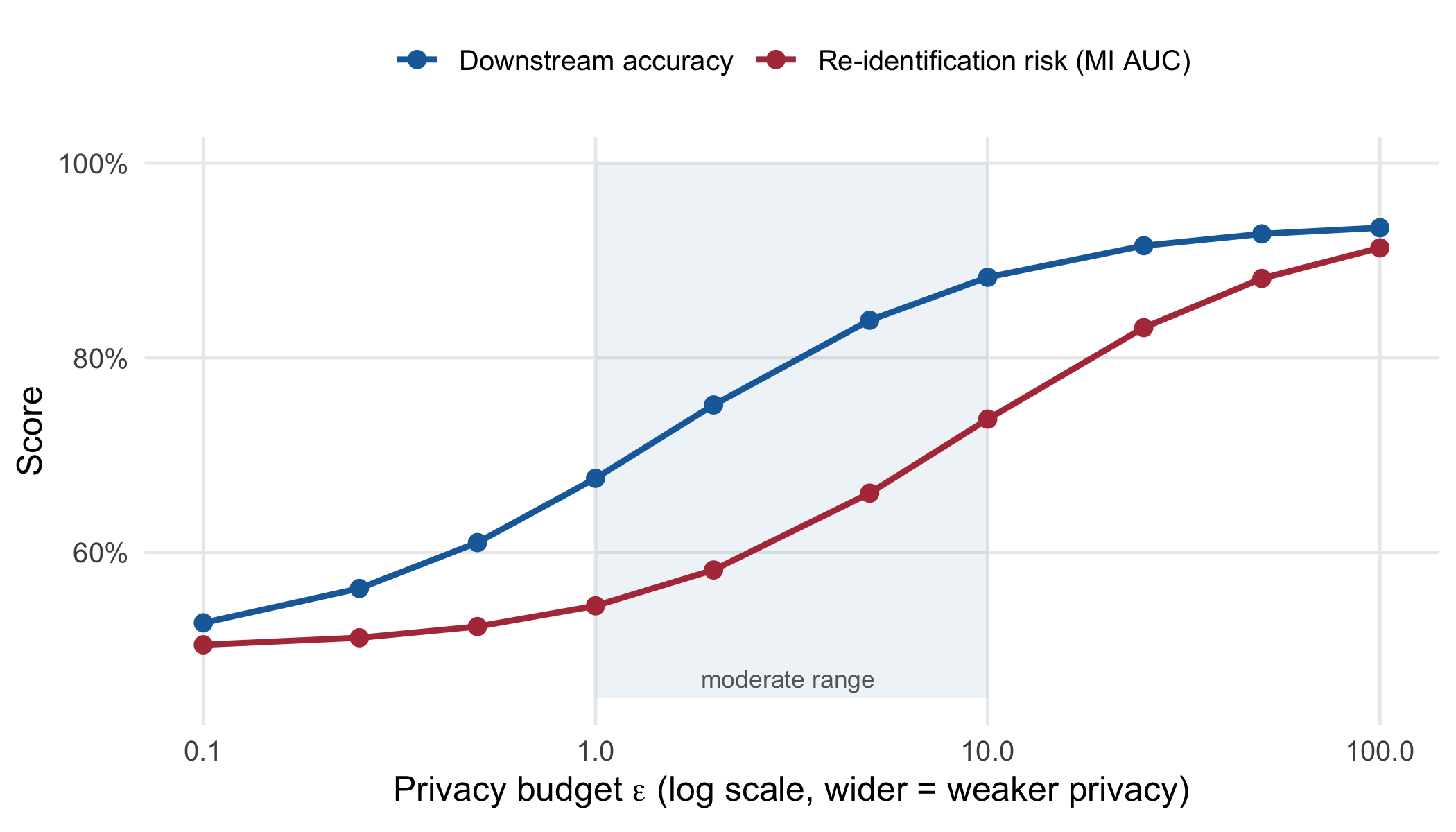
The tension is easiest to see as a single curve. Figure 6.2 traces downstream utility against the epsilon budget, alongside the re-identification risk that an audit would recover. The lesson to take is that the two curves move together: there is no epsilon that is both far to the left (private) and high on the utility line, so the operating point is a choice about which loss to accept rather than a value to be optimized away. The shaded band marks the moderate range where most cross-institutional work lands.
A working pattern:
from synthcity.plugins import Plugins

# DP-CTGAN with epsilon=2.0
gen = Plugins().get('dpgan', epsilon=2.0, delta=1e-5)
gen.fit(real_data)
synthetic = gen.generate(count=len(real_data))
The epsilon is reported in the methods section. The delta is set to roughly 1/n where n is the dataset size , the standard convention.
6.6 Re-identification audits
DP gives a formal privacy guarantee at the generator level. Auditing gives empirical evidence that the guarantee holds in practice and that no other privacy failures have crept in. Two attacks dominate.
Membership-inference attack. Given the synthetic data and a candidate record, can an adversary determine whether the candidate was in the training set? The attack is implemented as a classifier: train a model to distinguish ‘records whose nearest synthetic neighbor is very close’ from ‘records whose nearest synthetic neighbor is far’. The ‘in-training’ records tend to have closer synthetic neighbors (the generator overfits slightly). High accuracy on this classifier means the synthetic data leaks training-set membership.
from sklearn.metrics import roc_auc_score
from sklearn.neighbors import NearestNeighbors

def membership_inference_audit(real, synthetic,
                                holdout):
    '''Return AUC of distinguishing real-in-training
    from real-not-in-training based on distance to
    nearest synthetic neighbour.'''
    nn = NearestNeighbors(n_neighbors=1).fit(synthetic)
    in_dist, _ = nn.kneighbors(real)
    out_dist, _ = nn.kneighbors(holdout)
    distances = np.concatenate([
        in_dist.flatten(),
        out_dist.flatten(),
    ])
    labels = np.concatenate([
        np.ones(len(real)),
        np.zeros(len(holdout)),
    ])
    return roc_auc_score(labels, -distances)
AUC near 0.5 means the attack fails (good privacy). AUC near 1.0 means the attack succeeds (bad privacy). Practical thresholds: AUC > 0.6 is concerning, > 0.7 suggests the synthesis is close to a memorized copy.
Attribute-inference attack. Given the synthetic data and partial information about a candidate (e.g., age, sex, ZIP), can the adversary infer a sensitive attribute (diagnosis, lab value)? Implemented as a regression or classification model trained on the synthetic data predicting the sensitive attribute from the partial information. The attack succeeds if the model performs well on real held-out individuals.
The attack model trained on synthetic data is allowed to generalize; the question is whether it generalizes in a way that compromises real individuals. Measure performance on held-out real records and compare against a baseline (predicting the mode or marginal). Substantial improvement over baseline indicates leakage.
A useful framing: synthetic data should be auditable against the worst-case adversary the use case can plausibly produce. For internal use, the adversary is a curious colleague; auditing against light attacks is adequate. For external release, the adversary is a motivated attacker with substantial computing resources; auditing against state-of-the-art membership-inference techniques is appropriate.
6.7 HIPAA Safe Harbor and expert determination
For US clinical-data work, the privacy regime is HIPAA. Two paths to de-identification:
Safe Harbor. Remove 18 specified identifiers (names, dates more granular than year for ages > 89, ZIP codes above 3 digits, etc.) and assert no actual knowledge of re-identification. The dataset is then ‘de-identified’ under HIPAA and not protected health information (PHI). Synthetic data does not by default qualify for Safe Harbor, the question is whether the synthesis was trained on PHI, not whether the synthetic data contains identifiers in the listed categories.
Expert determination. A qualified expert determines that the risk of re-identification is ‘very small’. The expert’s determination is documented and accompanies the data. For synthetic data, the expert determination is typically the appropriate path: a statistician (often the researcher on the project) certifies that the synthesis method, the privacy budget, and the audit results together produce a dataset where re- identification risk is acceptably low.
The expert-determination path requires written documentation. The researcher produces a report that includes:
- The synthesis method and parameters.
- The DP budget (epsilon, delta) if applicable.
- The audit results (membership-inference AUC, attribute-inference performance).
- A risk assessment relative to the use case.
- A statement of the expert’s qualifications and conclusion.
The report is not boilerplate; it is the documented basis for the privacy claim. IRBs and journal reviewers will increasingly ask for it; preparing it after the fact is harder than as you go.
6.8 Worked example: releasing a synthetic surveillance file
We return to the state health department from the orientation. The department maintains a notifiable-disease surveillance system and wants external epidemiologists to develop analyses (age-standardized incidence, spatial clustering, disparities by race and ethnicity) without touching identifiable case records. The real file is 40,000 line-listed cases over five years with age, sex, county, race and ethnicity, onset date, and outcome. The alternative the department has used until now, small-cell suppression, blanks every sparse county-by-age cell and so hides precisely the rare strata that outbreak and disparities work depends on. Synthetic data is the proposed replacement.
Step 1: characterize the use case. The synthetic file will be posted publicly for unvetted external analysts and will persist indefinitely. The privacy regime is therefore strong. Target \(\epsilon = 1\) as the privacy budget. The utility requirement is that county-level incidence rates and the direction and rough magnitude of racial and ethnic disparities are preserved.
Step 2: choose the method. The data is mixed numeric- categorical, roughly a dozen variables, with sparse county-by-age-by-outcome strata. Following Table 6.1, a DP-synthesizer is indicated because release is public; Synthcity’s DP-CTGAN with \(\epsilon = 1, \delta = 10^{-5}\) is the chosen method.
Step 3: generate. A few hours of training, producing a synthetic file of 40,000 cases with the same variable structure and, unlike the suppressed file, populated small cells.
Step 4: audit utility. Recompute the analyses external users are expected to run. County-level incidence rates on the synthetic file are within roughly 10% of the real rates for well-populated counties, wider in the sparsest counties; the ranking of counties by rate is largely preserved. The disparity estimates keep their direction and approximate magnitude. On the plus side, the sparse strata that suppression destroyed are usable; on the minus side, the rate estimates in those strata carry visibly more noise, and the release documentation says so.
Step 5: audit privacy. Run the membership-inference attack using the audit code shown above. AUC = 0.52, the attack fails, as expected with \(\epsilon = 1\). Run an attribute-inference attack predicting outcome from age, sex, county, and race and ethnicity. The synthetic-data- trained classifier achieves AUC 0.61 on held-out real cases; the marginal baseline achieves 0.51. The 10-point improvement is modest but real; the department documents it and proceeds.
Step 6: write the expert-determination report. The department statistician documents the method, the DP parameters, and the audit results, and concludes that the re-identification risk is very small given the public purpose. Note that this file, being trained on PHI, does not qualify for Safe Harbor merely because it lists no names; expert determination is the operative path.
Step 7: release with documentation. The synthetic file is posted with a README recording the synthesis method, the privacy budget, the utility comparison (including the degraded small-cell precision), the audit results, and the expert determination. External epidemiologists can develop and publish analyses with full transparency about the synthetic nature of the data, and the department has avoided both disclosure and the analytic dead end of blanket small-cell suppression.
6.9 Collaborating with an LLM on synthetic data generation
Three prompt patterns illustrate working with LLMs on synthetic-data tasks.
Prompt 1: ‘Choose a synthesis method for this data shape and use case.’ Provide the data structure and the use case (internal use, external release, publication, software demo).
What to watch for. The LLM will recommend whichever method is most popular, often without checking whether it suits the specific data structure. For high- dimensional sparse-binary data (medical claims), the LLM may recommend CTGAN even though MedGAN is the appropriate tool. Push back: ask ‘what about MedGAN for this case?’
Verification. Run a small benchmark: try two or three candidate methods on a sample of the data and compare utility and runtime. The right choice is empirical.
Prompt 2: ‘Audit this synthetic dataset for privacy.’ Provide the synthetic data, a sample of real held-out data, and the schema. Ask for an audit plan and implementation.
What to watch for. The LLM will produce a reasonable audit plan including membership inference and attribute inference. It will not always check for less-common attacks (linkage to external data, model inversion). For high-stakes releases, supplement the LLM-produced audit with literature review of recent attack methods.
Verification. The audit code should run end-to-end and produce numbers. Check the numbers against your expectation: AUC near 0.5 for membership inference is expected with strong DP; substantially higher AUC means something is wrong.
Prompt 3: ‘Draft the expert-determination report for this synthetic dataset.’ Provide the method, parameters, audit results, and use case.
What to watch for. The LLM will produce a competent- looking report. The researcher must verify every claim, the LLM may confuse \(\epsilon\) values, mis- state the audit results, or over-state the privacy guarantees. The report is the basis for the privacy claim in the publication; it must be exactly right.
Verification. Read the report against the actual audit numbers. Confirm the privacy claim is supported by the audit. Confirm the expert qualifications and conclusion match what the researcher will sign.
The meta-pattern: LLMs accelerate the mechanics of synthetic-data work but cannot verify the privacy claim. The researcher owns the determination, the documentation, and the responsibility for the release.
6.10 Principle in use
Three habits define defensible work in this area:
Audit before release. Every synthetic dataset intended for external release passes a documented audit. The audit is not ‘we used DP’; the audit is numbers from membership-inference and attribute- inference attacks on the actual generated data.
Document the privacy budget explicitly. The methods section of any paper using synthetic data states the synthesis method, the privacy parameters (DP epsilon if used, no-DP otherwise), and the audit results. Reviewers should not have to ask.
Match the privacy regime to the use case. Public release demands stronger privacy than internal use. The researcher chooses the operating point deliberately and re-evaluates if the use case changes (e.g., from internal use to public release).
6.11 Exercises
Take a small research dataset of your choice and synthesize it with two methods (e.g., CTGAN and TVAE). Compare utility (correlation preservation, marginal preservation) and runtime.
Add differential privacy to your synthesis with \(\epsilon = 1, 5, 10\). Plot utility (e.g., hazard ratio of a key analysis) against epsilon.
Implement the membership-inference audit shown in this chapter. Run it on your synthetic datasets at each epsilon level.
Draft an expert-determination report for one of your synthetic datasets. Include method, parameters, audit results, and a privacy claim. Have a colleague review it.
Compare LLM-based tabular synthesis (using a reasoning model with the data dictionary and a sample) against CTGAN on the same dataset. Document the relative utility, cost, and scalability.
6.12 Further reading
- Dwork & Roth (2014), The Algorithmic Foundations of Differential Privacy. The textbook reference for DP.
- Xu et al. (2019), Modeling Tabular data using Conditional GAN. The CTGAN paper.
- Qian et al. (2023), Synthcity: facilitating innovative use cases of synthetic data in different data modalities. The reference for the Synthcity library.
- Choi et al. (2017), Generating Multi-label Discrete Patient Records using Generative Adversarial Networks. The original MedGAN paper.
- Buuren & Groothuis-Oudshoorn (2011), mice: Multivariate Imputation by Chained Equations in R. Adjacent: imputation as a synthesis-like operation, often appropriate when full synthesis is not.