flowchart TB
  S["Task with acceptance<br/>criteria and an eval suite"] --> R0{"Zero-shot prompting<br/>passes the eval suite?"}
  R0 -->|Yes| Stop["Stop. Do not climb.<br/>Higher rungs add cost,<br/>not quality."]
  R0 -->|No| R1{"Few-shot examples<br/>close the gap?"}
  R1 -->|Yes| Stop
  R1 -->|No| R2{"RAG over an<br/>institutional corpus<br/>closes the gap?"}
  R2 -->|Yes| Stop
  R2 -->|No| R3{"Is the gap in behaviour<br/>or style, not in<br/>missing facts?"}
  R3 -->|"No: facts are missing"| R2b["Improve the retrieval<br/>corpus, not the model"]
  R3 -->|"Yes: behaviour or style"| R4["PEFT: LoRA / QLoRA adapter<br/>1k to 10k labelled pairs"]
  R4 --> R5{"Adapter insufficient<br/>and labelled data<br/>plentiful?"}
  R5 -->|No| Stop
  R5 -->|Yes| R6["Full fine-tune<br/>10k to 100k+ pairs"]
  R6 --> R7{"Base lacks the domain's<br/>language entirely?"}
  R7 -->|No| Stop
  R7 -->|Yes| R8["Continued pretraining<br/>on a large domain corpus"]
13 Customisation and Adoption: Fine-Tuning, Distillation, and AI-Augmented Teams
If I have seen further it is by standing on the shoulders of Giants.
Isaac Newton, letter to Robert Hooke (1675)
13.1 Learning objectives
By the end of this chapter you should be able to:
- Apply a decision framework for when to customise: when context engineering is sufficient, when fine-tuning (PEFT/LoRA) is warranted, and when distillation or on- prem deployment is the right answer.
- Reason about institutional-data fine-tuning under HIPAA, including BAA constraints, audit requirements, and the reproducibility implications of model versioning.
- Design adoption patterns for research-analytics teams that reflect the cybernetic teammate evidence: AI-augmented individuals matching team-without-AI baselines, and the organizational R&D pattern for surfacing useful workflows.
- Distinguish productive adoption patterns (latent expertise at the edge, expert-in-the-loop verification) from anti-patterns (centralized IT prescription, AI as uncritical replacement).
13.2 Orientation
The decision to customise, fine-tune a model on institutional data, distill a smaller model from a larger one, deploy an open-weights model on-prem, is expensive in setup and maintenance. The default for most research-analytics teams should be context engineering: use a frontier API, supply institutional context per query through RAG and prompt scaffolding, and let the model do the work. Customisation pays off in a narrow set of cases that are worth identifying explicitly.
The adoption side of the chapter is equally important. The empirical evidence, Mollick’s Cybernetic Teammate RCT (Mollick, 2025) showing AI-enabled individuals matching the performance of unaugmented two-person teams, points to a specific adoption pattern that works: latent-expertise discovery at the team-member level, knowledge-sharing across the team, and gradual codification of useful patterns into team-level conventions. The anti-pattern, centralized IT prescription of when and how AI should be used, is documented to underperform.
The chapter develops three threads. The customisation decision: when context wins, when fine-tuning is warranted, when on-prem becomes necessary. PEFT and LoRA at a working level: enough to make sound choices without going into the training mechanics that belong in a different book. Adoption patterns for research-analytics teams: how to organize the team’s discovery and use of AI assistance so the team’s collective knowledge grows over time.
13.3 The researcher’s contribution
Three judgments are not delegable.
(Judgment 1.) The customisation question is a cost- benefit calculation, not an engineering preference. The temptation to fine-tune is strong: the customised model feels like it is ‘really yours’. The reality is that fine-tuning is expensive (in API cost, in infrastructure, in maintenance) and obsoletes when the underlying model is updated (which is often). Most of the time, the right answer is context engineering with a frontier API. The researcher evaluates the trade rather than defaulting to one or the other.
(Judgment 2.) Adoption is the longest-lived artifact. Specific models change every few months; specific tools change every year. The team’s disposition toward AI-assisted work, the habits of specification, verification, and disclosure, outlast all of them. The researcher shapes the team’s adoption pattern with the long view in mind: build habits that survive the next model release.
(Judgment 3.) Centralized prescription does not work. The Mollick RCT and the Latent Expertise (Mollick, 2024) argument both point in the same direction: useful AI applications are discovered by individual practitioners in their own work, not prescribed by IT. The researcher’s role is to encourage individual experimentation, share what works, and treat the discovery process as part of the work. Trying to mandate specific tools or prompts from above produces compliance theater rather than productivity.
These judgments are what distinguish thoughtful adoption from the patterns that produce expensive failures (over-customised stacks, mandated tooling that no one uses).
13.4 Decision framework: when to customise
We find it helpful to picture the options as a ladder, ordered from cheapest and least data-hungry at the bottom to most expensive and most data-hungry at the top: prompting, few-shot examples, RAG, parameter- efficient fine-tuning (LoRA/QLoRA), full fine-tuning, and continued pretraining. Figure 13.1 renders the ladder as a decision tree. The rule for climbing is the same at every rung: climb only when the rung below demonstrably fails the team’s evaluation suite (Chapter 10), never because a higher rung feels more thorough. Each step up multiplies cost and the labeled data required, and most teams should stop within the first two or three rungs.
A decision tree of this shape organizes the remaining choice once the lower rungs are exhausted.
Step 1: Is context engineering insufficient?
Most tasks can be addressed by frontier-API + good context (system prompt + retrieved documents + structured input/output). If the model produces acceptable results with this setup, do not customise. Customisation pays off when context is genuinely insufficient, not when it is annoying to set up.
Signs context engineering is sufficient:
- The frontier API produces correct output most of the time on the team’s tasks.
- The remaining failures can be addressed by improved prompts or retrieval.
- The latency and cost are acceptable.
Signs context engineering is genuinely insufficient:
- The model consistently fails on tasks that require domain-specific terminology or conventions even with substantial context.
- The required context is so large it does not fit in the context window, or so complex that retrieval cannot reliably find the right pieces.
- Latency is unacceptable due to the size of context required per query.
Step 2: If insufficient, what kind of customisation?
Three customisation paths.
Fine-tuning (PEFT / LoRA) trains a small adapter on top of a frontier model, leaving the base model intact. The adapter encodes specific behaviors (domain terminology, response style, structured- output conventions) without retraining the base. PEFT methods like LoRA (Hu et al., 2022) add a few million parameters; QLoRA (Dettmers et al., 2023) adds quantization to make training feasible on modest hardware. Cost: thousands of dollars in compute and some weeks of work. Maintenance: the adapter needs re-training when the base model is updated, which is non-trivial.
Distillation trains a smaller model to mimic a larger one on the team’s tasks. The result is a smaller, faster, cheaper model that performs well on the specific tasks but does not have the larger model’s general capabilities. Useful when high-volume inference cost is the binding constraint.
On-prem open-weights deployment runs an open- weights model (BioMedLM (Bolton et al., 2024), Llama 3, Mistral) on the institution’s infrastructure. The trade is operational: gain on-prem control of the data and the model; lose the convenience of a managed API. For PHI-heavy use cases where API configuration is not adequate, this is the path.
Step 3: Match path to use case.
| Use case | Recommended path |
|---|---|
| Domain-specific style or output format | LoRA fine-tune |
| High-volume inference at low latency | Distill to smaller model |
| Strict on-prem requirement (PHI, contractual) | Open-weights on-prem |
| Most everything else | Context engineering |
A common pattern: start with context engineering, observe what specifically is failing, and customise narrowly to address that. A blanket fine-tune of a frontier model because ‘we want our own model’ is rarely the right answer.
13.4.1 A resource-constrained public-health example
To illustrate, consider a county health department with a three-person analytics unit. Communicable-disease case reports arrive as free-text clinician narratives, and the unit must code each into a structured set of reportable- condition categories for surveillance. The frontier-API budget is small, the reports are PHI (so nothing leaves the department’s own infrastructure without a data-use review), and the labeled set is thin: roughly 300 reports a prior analyst hand-coded. The unit weighs two options: a RAG system that retrieves the case-definition guidance and a few coded exemplars per query, or a LoRA fine-tune on the 300 labeled reports.
The ladder in Figure 13.1 settles it. RAG, with few-shot prompting over the exemplars, sits below LoRA on the ladder and demands no labeled training set, only the case definitions and a handful of examples. LoRA, by contrast, wants on the order of 1,000 to 10,000 labeled pairs (Table 13.1), and 300 is well short; an adapter trained on so few examples would likely overfit to the prior analyst’s idiosyncrasies without generalizing. On the plus side, RAG keeps the case definitions explicit and auditable, which matters when a coding decision may later be questioned. On the minus side, if the narratives lean on local abbreviations and shorthand that no general model has seen, retrieval of case definitions may not be enough, and the department may find that a small QLoRA adapter, trainable on a single on-prem GPU and keeping PHI in house (Dettmers et al., 2023), is warranted once it has labeled enough reports to train on. The disciplined path is to climb only when the rung below demonstrably fails: begin with RAG plus few-shot, measure against a held-out set of coded reports, and reserve the adapter for the gap that remains. Should on-prem fine-tuning become necessary, a model already pretrained on clinical text, such as GatorTron (Yang et al., 2022), is the natural base, since it has seen the register in which case reports are written.
13.5 PEFT, LoRA, and distillation at a working level
Three concepts at the level a researcher needs to make sound choices.
LoRA: low-rank adaptation. Instead of fine-tuning all parameters of a model, LoRA adds small low-rank matrices to specific layers. The adapter has 0.1–1% as many parameters as the base model. Training the adapter is much cheaper than full fine-tuning and empirically achieves similar performance on most tasks (Hu et al., 2022).
The training process:
- Collect training data, usually 1,000–10,000 examples of input/output pairs in the desired style.
- Set up a LoRA training environment (Hugging Face
peftlibrary is the reference). - Train the adapter for a small number of epochs (1–3 typically), monitoring loss on a held-out set.
- Evaluate on a downstream task suite (the evaluation suite from Chapter 10).
- If acceptable, deploy: the base model is loaded plus the adapter at inference time.
QLoRA: quantized LoRA. LoRA combined with 4-bit quantization of the base model. Quantization reduces memory requirements substantially, enabling LoRA training on a single high-end GPU instead of a multi-GPU cluster. The quality penalty is small for most tasks. QLoRA is what makes LoRA training tractable for individual research groups in 2026.
Adapter management. Multiple LoRA adapters can be trained for the same base model, one for code generation in the team’s house style, another for methods drafting in the team’s voice, another for RoB assessment. At inference, the appropriate adapter is loaded for the task. Adapter swapping is cheaper than maintaining multiple full models and is the emerging pattern for organization-specific customisation.
Maintenance. When the base model is updated (a new release of the same family, e.g., Llama 3.5 → Llama 4), the adapter does not automatically transfer. Re-training is required to get the benefits of the base-model improvements while preserving the customised behavior. This maintenance overhead is the under-appreciated cost of fine- tuning.
Distillation is conceptually different. A smaller student model is trained to imitate a larger teacher model’s outputs on a target distribution of tasks. The student is faster and cheaper at inference but lacks the teacher’s capability outside the trained distribution.
For applied analytic work, distillation makes sense when:
- A specific repetitive task dominates inference cost (e.g., abstract screening for a living systematic review).
- The teacher model’s capability on that task can be captured by the student.
- The deployment constraints favor the smaller model (latency, cost, on-prem).
The distillation workflow is more involved than LoRA but well-supported by libraries like Hugging Face transformers.
13.5.1 Named techniques, distinguished
It is worth resisting the habit of calling all post- training simply ‘fine-tuning’, since the term now covers several techniques that differ in what they change, what they cost, and what data they consume. We distinguish five families.
Instruction tuning continues supervised training on a corpus of instruction/response pairs so that the base model follows instructions rather than merely continuing text. It is what turns a raw pretrained model into a usable assistant, and it operates on the full parameter set. For a team using a frontier API this step is already done; it becomes the team’s concern only when starting from a raw open-weights base.
Parameter-efficient fine-tuning (PEFT) covers the adapter family: Houlsby-style adapters (Houlsby et al., 2019), LoRA (Hu et al., 2022), and QLoRA (Dettmers et al., 2023). These freeze the base and train a small set of added parameters. They differ mainly in where the added parameters sit and how the base is stored: adapters insert new layers, LoRA adds low-rank matrices to existing layers, and QLoRA does the same over a 4-bit-quantized base so that training fits on a single GPU.
Reinforcement learning from human feedback (RLHF) trains a reward model on human preference comparisons and then optimizes the policy against that reward; it is the technique behind the aligned behavior of models such as Llama 2 (Touvron et al., 2023). Constitutional AI (Bai et al., 2022) substitutes AI-generated feedback against a written set of principles for much of the human labeling. RLHF is effective but operationally heavy: a separate reward model, an unstable optimization, and substantial preference data.
Direct preference optimization (DPO) reaches a similar objective to RLHF, making preferred outputs more likely than dispreferred ones, without training a separate reward model or running reinforcement learning; it optimizes a preference loss directly. For teams that want preference alignment but not the RLHF machinery, DPO is the more tractable option.
Continued pretraining takes a general base and trains it further on a large domain corpus so that it acquires vocabulary and register the base lacks. This is how models such as GatorTron (Yang et al., 2022) come to read clinical text fluently. It is the most expensive rung on the ladder and is rarely in scope for a team that uses models rather than builds them.
For the great majority of research-analytics teams, none of the preference-alignment or continued-pretraining techniques is in scope; they are the province of groups building models. We name them so that the vocabulary is clear, since these terms are used loosely in practice and the distinctions matter when reading a model card or a methods section.
Table 13.1 sets the techniques side by side. The reader may treat the final column as a rough decision rule: the appropriate method is the cheapest one whose ‘when appropriate’ condition matches the task.
| Method | Parameters trained | Data needed | Compute | When appropriate |
|---|---|---|---|---|
| Prompting (zero/few-shot) | None | 0–20 examples | Inference only | Default; always try first |
| RAG | None | A corpus, not labels | Index + inference | Answer needs a specific corpus |
| Instruction tuning | All (~billions) | 10k–1M pairs | Multi-GPU | Starting from a raw base model |
| Adapters | ~0.5–5% | 1k–10k pairs | Single GPU | Behavior gap; modular per-task swapping |
| LoRA | ~0.1–1% | 1k–10k pairs | Single GPU | Behavior or style gap; standard PEFT |
| QLoRA | ~0.1–1% | 1k–10k pairs | Single modest GPU | LoRA when GPU memory is the binding limit |
| Full fine-tune | All (~billions) | 10k–100k+ pairs | Multi-GPU | PEFT insufficient and data plentiful |
| Continued pretraining | All (~billions) | Large domain corpus | Large cluster | Base lacks the domain’s language |
| RLHF | Policy + reward model | 10k–100k preferences | Multi-GPU, unstable | Aligning behavior to preferences |
| DPO | All or a PEFT subset | 10k–100k preferences | One to a few GPUs | Preference alignment without the RL machinery |
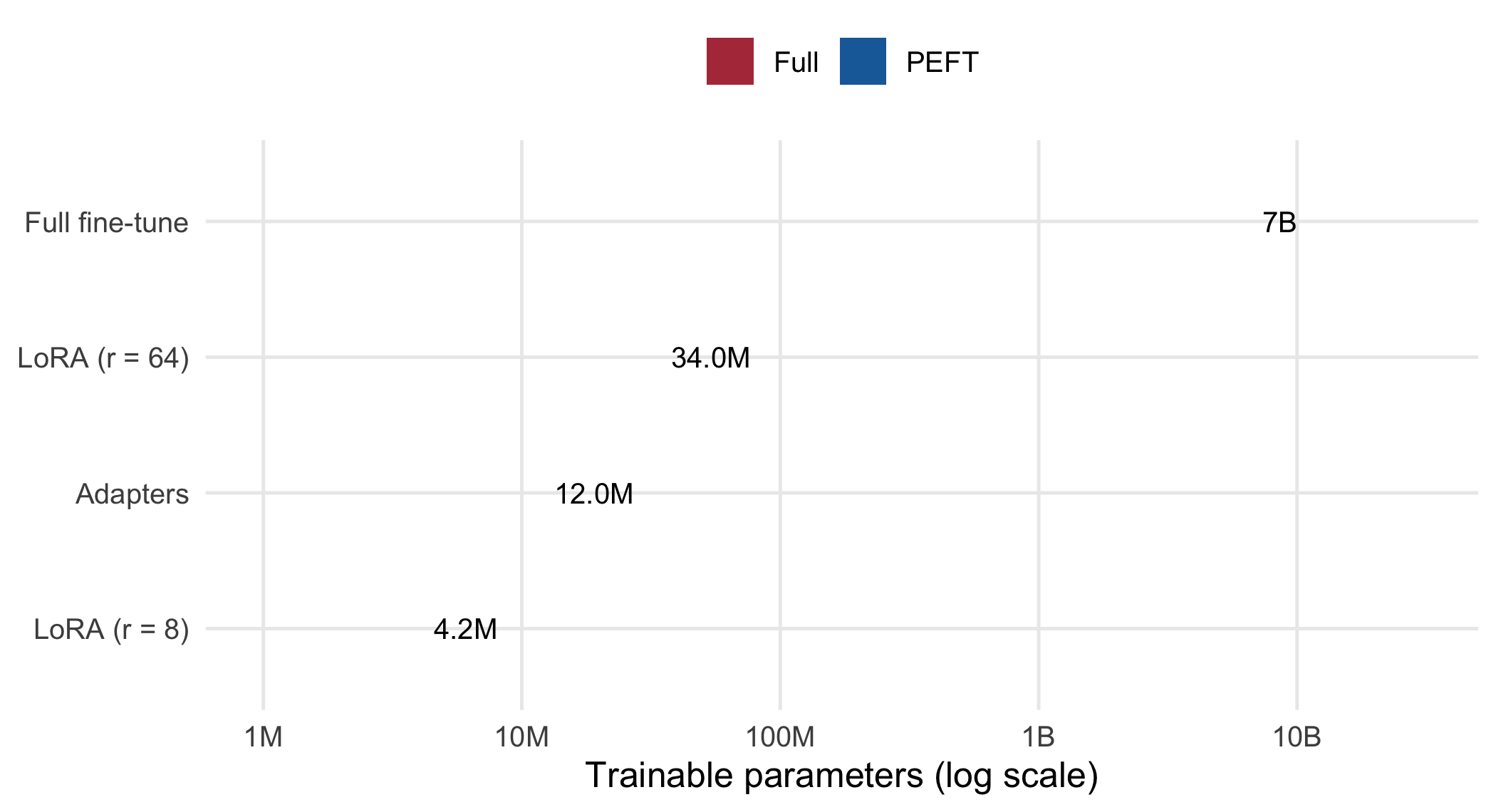
The parameter-count column is the crux of the PEFT argument. Figure 13.2 makes it concrete: on a log scale, the trainable-parameter counts span more than three orders of magnitude, which is the whole reason PEFT is attractive. LoRA and QLoRA move a few million parameters where a full fine-tune moves billions, and empirically reach comparable task performance (Hu et al., 2022).
13.6 Adoption in research-analytics teams
Mollick’s Cybernetic Teammate RCT (Mollick, 2025) studied 776 professionals at Procter & Gamble in a 4-arm trial: alone or in two-person teams, with or without AI access, on realistic product-development tasks. Findings:
- AI-enabled individuals matched the performance of two-person teams without AI (about a 0.37 SD improvement over baseline).
- AI-enabled teams outperformed non-AI teams, especially on the production of exceptional solutions.
- AI dissolved the expertise silo between R&D and commercial specialists; participants using AI reported higher positive emotion and lower anxiety.
We note that these are randomized results, which is still uncommon in this literature and worth weighting accordingly; the emerging body of RCT-style evidence on human-AI teaming, of which this is a leading example, is what lets us speak about effect sizes at all rather than anecdote. On the other hand, the setting (product- development tasks at a consumer-goods firm) is not health research, so the magnitudes should be read as indicative rather than directly transportable to a research- analytics group.
The implications for a research-analytics team:
Individual capability rises. A researcher working with AI assistance can produce work that previously required the researcher plus a junior researcher. The team’s effective capacity increases by some multiplier, the empirical estimates vary but are substantial.
Cross-discipline collaboration improves. A researcher collaborating with a clinician using AI on both sides can communicate more efficiently; the AI assists in translation across vocabularies. Cross-discipline projects that previously had high coordination cost become more tractable.
The right unit is the augmented individual, not the augmented team. Many AI deployments default to ‘the team uses AI’ when the more productive pattern is ‘each person uses AI in their own work and shares what works’. The team-level pattern emerges from the individual-level adoption.
13.7 Latent expertise: organizational R&D patterns
Mollick’s Latent Expertise observation (Mollick, 2024) is that the most useful AI applications are discovered by individual practitioners in their own work, not prescribed by IT or product teams. The pattern that produces value is:
- Individuals experiment with AI in their work.
- Useful patterns emerge.
- Successful patterns are shared with peers.
- Peers adapt and refine.
- The team gradually codifies what works into conventions.
- Codification feeds into onboarding for new team members.
This is recognizably a research-and-development pattern, applied to AI workflow. It works because it respects the diversity of work in the team, each researcher’s tasks are slightly different, and allows local optimization.
The anti-pattern is centralized prescription: ‘the research-analytics team will use Tool X for Task Y, and will use Prompt Z for Sub-task W’. This produces compliance theater (people use the prescribed tool when watched, and their own tools the rest of the time) and misses the workflow innovations that come from people who actually do the work.
The researcher (or team lead) supporting good adoption:
- Encourages individual experimentation with AI tools.
- Sets up channels (Slack, internal Wiki, weekly show-and-tell) where people share what works.
- Captures successful patterns into shared conventions: a team prompt library, a team evaluation suite, a team’s idiomatic API configuration.
- Onboards new team members into the conventions rather than into individual tools.
- Periodically refreshes the conventions as new patterns emerge.
A specific working pattern for a 6–10 person research-analytics group:
- A shared
prompts/directory in the team’s internal repo, with per-task prompt templates. - A
runbooks/directory with specific workflows (e.g., ‘how we do RoB assessment with LLM assistance’). - A weekly 30-minute show-and-tell where one person demonstrates a recent AI workflow that worked well.
- A monthly update to the team’s evaluation suite based on lessons learned.
13.8 Worked example: a research-analytics team’s first 6 months
A research-analytics group of 7 people adopts AI assistance starting Q1 2026. The trajectory:
Month 1: individual experimentation. Each team member is given a frontier API budget (~$50/month) and encouraged to try AI assistance on routine work. A weekly meeting captures observations, frustrations, discoveries.
Month 2: emerging patterns. Three patterns have clear value: (1) boilerplate code generation, (2) methods-section drafting, (3) literature scoping. The team agrees informal conventions: AI-drafted methods sections are reviewed by another team member before submission, AI-generated code is run with test data before commitment.
Month 3: codification. The team builds a shared prompt library for the three patterns. The library includes example outputs and the verification regime expected for each. Each team member contributes their working prompts.
Month 4: evaluation. The team builds an evaluation suite (per Chapter 10) with 25 tasks reflecting their actual work. They evaluate the frontier API on the suite as a baseline; they will re-run the evaluation when models update.
Month 5: workflow integration. The patterns are integrated into the team’s standard workflows. Methods-drafting templates link to the methods- drafting prompts. The team’s analytical SOPs include verification steps that explicitly cover AI-generated artifacts. Onboarding for a new junior researcher includes the conventions.
Month 6: customisation question. The team considers fine-tuning. Looking at the data, the only task where context engineering consistently underperforms is generating SAS code in the institution’s house style (deep PROC SQL nesting, specific macro libraries). They build a 200-example library, set up retrieval over it, and find the results match their target. They decide against fine-tuning at this stage; the example-library approach works.
6-month retrospective. The team’s effective capacity has increased materially (rough estimate: 30–40% more analytical output for the same headcount). Junior researchers are productive on tasks that previously required senior involvement. The team’s analytical reports are more thoroughly prepared because the AI-assisted drafting frees time for review. No clinical errors attributable to AI assistance have been reported; verification has caught all material errors before they reached publication.
The pattern reproducible: encourage experimentation, share what works, codify patterns, defer customisation until clearly necessary.
13.9 Collaborating with an LLM on customisation and team adoption
Three prompt patterns illustrate working with LLMs on adoption-shaped problems.
Prompt 1: ‘Should we fine-tune for this task?’ Provide the task description and the current context-engineering performance.
What to watch for. The LLM tends to recommend fine-tuning when context engineering would suffice. Push back: ‘what would have to be true for context engineering to fail here? have we tested those conditions?’
Verification. The decision is empirical. Run the context-engineering version against the evaluation suite; if it scores below the team’s threshold, investigate why. Often the failure is improvable without fine-tuning.
Prompt 2: ‘Help our team adopt AI for analytic work.’ Provide the team’s structure and current processes.
What to watch for. The LLM tends to recommend top-down rollouts: ‘choose a tool, train the team, mandate use’. The Mollick evidence suggests bottom-up adoption is more effective. Push toward patterns that respect individual variation.
Verification. Read the LLM’s recommendations against the Cybernetic Teammate and Latent Expertise findings. If the recommendations are top-down-prescriptive, modify them.
Prompt 3: ‘Build a prompt library for our team.’ Provide a list of the team’s tasks.
What to watch for. The LLM produces a competent draft library. The library is a starting point; the team owns it and refines it. Do not adopt the LLM’s prompts wholesale without team review.
Verification. Each prompt in the library is tested against representative tasks before adoption. The team’s evaluation suite is the criterion.
The meta-pattern: adoption is a team practice, not a tool-purchase decision. The LLM accelerates the construction of artifacts (prompt libraries, runbooks, evaluation suites) but the team’s disposition and discipline are what make them work.
13.10 Principle in use
Three habits define defensible work in this area:
Default to context engineering. Fine-tuning is expensive and obsoletes; context engineering is cheap and survives base-model updates. Customisation is for when context demonstrably fails.
Encourage individual discovery. Adoption emerges at the team-member level. The team lead’s job is to surface and codify patterns, not to prescribe them.
Treat conventions as living. The team’s prompt library, evaluation suite, and runbooks are living artifacts updated as patterns evolve. A frozen library decays.
13.11 Exercises
Catalog your team’s routine tasks. For each, identify whether context engineering, fine-tuning, or distillation is the right starting point.
Build a prompt library entry for one of your team’s most common tasks. Include the prompt, example inputs, expected outputs, and verification steps.
Run a 4-week experiment in your team: each member tracks one AI-assisted task per week. Aggregate the patterns at the end of the month.
Calculate the cost of a LoRA fine-tune for a task you would consider customising. Include compute, training data construction, and maintenance over a year. Compare to context engineering.
Audit your team’s current AI adoption. Identify one centralized prescription and one bottom-up pattern. Reflect on which is producing more value.
13.12 Further reading
- Hu et al. (2022), LoRA: Low-Rank Adaptation of Large Language Models. The reference paper for the LoRA method.
- Dettmers et al. (2023), QLoRA: Efficient Finetuning of Quantized LLMs. The reference for the quantization-plus-LoRA approach that makes fine-tuning practically accessible.
- Houlsby et al. (2019), Parameter-Efficient Transfer Learning for NLP. The earlier adapter-based PEFT paper that informs the LoRA family.
- Bolton et al. (2024), BioMedLM. The open-weights biomedical language model that is the natural starting point for biomedical on-prem deployment.
- Yang et al. (2022), GatorTron. A clinical language model produced by continued pretraining on a large corpus of electronic-health-record text; illustrates the top rung of the ladder.
- Touvron et al. (2023), Llama 2. Documents an open-weights model whose aligned behavior comes from an RLHF pipeline.
- Bai et al. (2022), Constitutional AI. Replaces much of the human preference labeling in RLHF with AI feedback against written principles.
- Mollick (2025), The Cybernetic Teammate. The RCT evidence underwriting the augmented-individual framing.
- Mollick (2024), Latent Expertise: Everyone is in R&D. The argument for bottom-up adoption.