flowchart TB
  subgraph idx [Index time: done once, refreshed as corpus grows]
    direction LR
    A["Source corpus<br/>PubMed, MMWR, WHO<br/>guidance, protocols, SOPs"] --> B["Chunk<br/>by document structure"]
    B --> C["Embed<br/>dense vectors"]
    C --> D[("Vector index<br/>+ BM25 index")]
  end
  subgraph qry [Query time: runs on every question]
    direction LR
    Q["Researcher<br/>query"] --> E["Hybrid retrieve<br/>dense + BM25, RRF"]
    E --> F["Re-rank<br/>cross-encoder"]
    F --> G["Generate<br/>cite chunk IDs,<br/>refuse if empty"]
    G --> H["Verify citations<br/>against retrieved set"]
  end
  D -.-> E
5 Retrieval-Augmented Generation over Biomedical Corpora
Knowledge is of two kinds. We know a subject ourselves, or we know where we can find information upon it.
Samuel Johnson, in Boswell’s Life of Johnson (1775)
5.1 Learning objectives
By the end of this chapter you should be able to:
- Build a RAG pipeline over biomedical corpora (PubMed, clinical guidelines, protocol libraries) with appropriate chunking, embedding, and retrieval choices.
- Distinguish dense retrieval, sparse (BM25) retrieval, and hybrid approaches, and choose between them for a biomedical task.
- Implement citation-grounded generation that cites the retrieved sources and refuses to fabricate when retrieval is empty.
- Evaluate a RAG system with retrieval-quality metrics (recall, MRR) and end-to-end answer-quality metrics (RAGAS-style faithfulness, answer relevance).
5.2 Orientation
A reasoning model with a million-token context window can hold a few hundred pages of text. PubMed has 35 million abstracts. The gap between the two is the problem retrieval-augmented generation (RAG) solves. RAG pipelines retrieve a small set of documents relevant to a query and pass them to the model as context, so the model can produce a grounded answer that cites the retrieved sources rather than relying on its training distribution alone.
For clinical and public-health researchers, RAG is the right architecture when the answer needs to draw on a specific corpus that the model was not trained on (or was trained on incompletely): institutional protocol libraries, regulatory submissions, recent literature, internal SOPs, the team’s prior trial reports. The RAG output is defensible in a way that pure model output is not, the citations exist and can be checked, and is stable against the training cutoff: a RAG over current PubMed will reflect last week’s papers, while the underlying model’s training data may be a year stale.
The staleness argument is at its sharpest in public health. Consider an epidemiologist tracking a novel respiratory outbreak in the first weeks after it is recognized. The relevant case definitions, transmission estimates, and interim guidance are being revised almost daily, and none of it existed when the model was trained. A model asked directly will answer confidently from a world that predates the outbreak. A RAG pointed at the current CDC Morbidity and Mortality Weekly Report series, WHO Disease Outbreak News, and the preprint literature will answer from this week. The difference is not a matter of polish; it is the difference between guidance that is current and guidance that is quietly obsolete. But how do we build such a pipeline so that it retrieves the right material, and refuses gracefully when it cannot? That question organizes the chapter.
Figure 5.1 gives the shape of the whole system before we take it apart stage by stage.
The chapter develops three concerns. Retrieval: chunking, embedding, search strategy. Generation: prompting the model to cite, refuse when retrieval is empty, and avoid mixing retrieved facts with parametric knowledge. Evaluation: how to know whether the pipeline is working, separately for the retrieval step and for the end-to-end answer.
5.3 The researcher’s contribution
Three judgments are not delegable.
(Judgment 1.) Corpus selection is part of the analysis. A RAG pipeline is only as defensible as the corpus it retrieves from. A pipeline pointed at all of arXiv plus all of PubMed will produce different answers from one pointed at the team’s institutional protocol library alone. The researcher decides what corpus to include, what to exclude, and what to disclose. A literature-search RAG that silently excludes papers from journals not in PMC is a methodological artifact, not a systematic search.
(Judgment 2.) The retrieval failure mode determines the answer’s reliability. A RAG pipeline can fail in two ways: it retrieves the wrong documents (and the model produces a confident answer based on irrelevant material), or it retrieves nothing and the model falls back on parametric knowledge (and produces an answer that looks grounded but is not). The researcher designs the pipeline to fail loudly: a ‘no relevant documents found’ response that the model is instructed to honor, rather than a graceful degradation that hides the retrieval failure.
(Judgment 3.) The evaluation contract. RAG evaluation is not a one-time benchmark; it is an ongoing discipline. A pipeline that worked yesterday on sample queries may fail today on production queries because the corpus drifted, the embedding model was swapped, or the chunking changed. The researcher sets up evaluation queries that are run periodically and treats degradation as a maintenance problem, not a catastrophe.
These judgments are what distinguish a RAG-supported analysis from one that uses RAG as a way to launder unsupported claims through the appearance of citation.
5.4 Embeddings and retrieval for biomedical text
A RAG pipeline has four stages: chunk the source corpus into retrievable units, embed each chunk into a vector representation, store the embeddings in a searchable index, and at query time embed the query and find the nearest chunks. Each stage has biomedical-specific considerations.
Chunking strategy. The unit of retrieval matters. Chunks too small lose context (a single sentence stripped from its paragraph is rarely useful); chunks too large dilute the embedding (a 10,000-token chunk gets a single average vector that does not represent any specific piece). The default convention for general text is 500–1,000 tokens per chunk with 100–200 token overlap. For biomedical text, the structure of the source matters more than token counts: a PubMed abstract is naturally one chunk; a clinical guideline section is naturally one chunk; a randomized-trial paper benefits from chunking by section (Methods, Results, etc.) so a query about a specific outcome retrieves the relevant Results paragraph rather than the whole paper.
For protocol documents and SOPs, chunk by section header and include the section title in the embedding text. The title acts as a strong signal for the embedding model and improves retrieval precision.
Embedding model. General-purpose embedding models (OpenAI text-embedding-3-large, Cohere embed-v3) work well on biomedical text but lose to domain-specific models on technical retrieval tasks. BiomedCLIP (Zhang et al., 2025), BiomedBERT-derived embeddings, and SapBERT are designed for biomedical use and outperform general-purpose models on UMLS-concept- linking tasks. For most applications, a strong general- purpose model is the right starting point; switch to domain-specific only when retrieval quality is demonstrably inadequate.
Index choice. For corpora under a few hundred thousand chunks, a flat in-memory index (FAISS-IVF, HNSWlib, or even an in-memory dense vector list) is sufficient and avoids the operational overhead of a managed vector database. For larger corpora, hosted vector stores (Pinecone, Weaviate, pgvector with HNSW) are appropriate. The performance differences within the small-corpus regime are minor compared with the chunking and embedding choices upstream.
Retrieval strategy. Three approaches, ranked by typical performance on biomedical tasks.
Sparse (BM25) retrieval computes a token-overlap score between query and chunk. It is fast, cheap, and strong on queries that share rare terms with the source (drug names, gene names, specific clinical terminology). It misses semantic matches: a query about ‘hypertension’ will not retrieve a chunk about ‘high blood pressure’ unless the term is also present.
Dense retrieval uses the embedding model: query and chunks are embedded, and the nearest chunks by cosine similarity are retrieved. Dense retrieval handles semantic matches well but underperforms BM25 on rare- term queries because the embedding model averages over many tokens.
Hybrid retrieval combines both: retrieve top-k from each, merge with a weighted combination, and re-rank. The reciprocal-rank-fusion (RRF) algorithm is a clean implementation: it combines rankings from multiple retrievers without requiring score calibration. Hybrid retrieval is the default recommendation for biomedical RAG; the additional engineering is small and the retrieval quality is consistently better.
Table 5.1 summarizes the three strategies side by side. The reader designing a first pipeline may treat the final column as a decision rule: start hybrid unless there is a specific reason not to.
| Strategy | Matches on | Strong when the query | Weak when the query | Cost |
|---|---|---|---|---|
| Sparse (BM25) | Exact token overlap | Shares rare terms (drug, gene, ICD codes) | Uses a synonym (‘high blood pressure’ vs ‘hypertension’) | Very low |
| Dense | Semantic similarity | Is phrased unlike the source | Turns on a rare term diluted in the average | Moderate |
| Hybrid (RRF) | Both, fused by rank | Is either of the above, or a mix | Rarely; failure modes are complementary | Moderate |
def rrf_merge(rankings, k=60):
    '''Reciprocal-rank fusion of multiple rankings.'''
    scores = {}
    for ranking in rankings:
        for rank, doc_id in enumerate(ranking):
            scores[doc_id] = scores.get(doc_id, 0) + 1 / (
                k + rank
            )
    return sorted(scores, key=scores.get, reverse=True)
Re-ranking. After initial retrieval, a re-ranker model (a cross-encoder, smaller and slower than the embedding model, but more accurate) can re-score the top-k retrieved chunks for the query. Re-ranking adds modest latency for substantial precision gains and is worth implementing for any RAG that informs a substantive decision. The MedRAG benchmark (Xiong et al., 2024) demonstrates that re-ranking is the single largest lever in biomedical RAG performance after the initial retrieval choice.
5.5 Citation-grounded generation
The generation step takes the retrieved chunks and the query and produces an answer. The discipline that distinguishes good RAG from bad is citation grounding: the generated answer cites which chunk supports each claim, and the model is instructed to refuse when retrieval is empty.
Three patterns work in practice.
Pattern 1: Inline citations with chunk IDs. The prompt instructs the model to cite each substantive claim by chunk ID:
Answer the question below using ONLY the provided
chunks. Cite each substantive claim with the chunk ID
in square brackets, e.g. [chunk_42]. If the chunks do
not contain enough information to answer, say so
explicitly.

CHUNKS:
[chunk_12] (PubMed PMID 12345678): The PIONEER 6 trial
randomised 3,183 patients with type 2 diabetes...
[chunk_15] (PubMed PMID 23456789): Cardiovascular
outcomes were assessed with a composite endpoint...
[...]

QUESTION:
What was the primary cardiovascular outcome of the
PIONEER 6 trial, and what proportion of patients
experienced it?
The output looks like: ‘The primary outcome was a composite of cardiovascular death, non-fatal MI, and non-fatal stroke [chunk_15]. The composite occurred in 3.8% of the oral semaglutide arm and 4.8% of the placebo arm [chunk_12]’. The researcher can verify each citation by going to chunk_15 and chunk_12 in the retrieved set.
Pattern 2: Refusal on empty retrieval. The prompt instructs the model to refuse if the retrieved chunks do not contain the answer. The honest refusal is ‘According to the retrieved sources, I cannot answer this question. The retrieved chunks discuss [topic], but not [specific question].’ The temptation to fall back on parametric knowledge (‘Based on general medical knowledge, the answer is…’) is strong; the prompt should explicitly prohibit it.
Pattern 3: Source attribution at the chunk level. Each chunk should include its source metadata in the embedding text and in the LLM context. For PubMed: the PMID, title, authors, year. For guidelines: the guideline name, section, version. For institutional documents: the document name and version. The attribution makes citations traceable and provides the researcher with the path to verify each cited claim.
A failure mode worth naming: citation hallucination inside RAG. Even with retrieved chunks in context, models occasionally cite sources that are not in the retrieved set, mis-attribute claims to the wrong chunk, or invent chunk IDs. The fix is post-processing: parse the model’s citations, verify each citation exists in the retrieved set, and either drop unverifiable citations or mark them in the output. The verification is a few lines of code and catches this failure reliably.
5.6 Evaluating a biomedical RAG pipeline
RAG evaluation has two layers: retrieval quality (did we retrieve the right chunks?) and answer quality (given the retrieved chunks, did the model produce a good answer?). Evaluating only the end-to-end answer hides which layer is failing when results disappoint.
Retrieval evaluation. Construct a labeled query set: 50–200 representative queries, each paired with the chunk IDs that should be retrieved for the answer. The construction is manual and time-consuming but is the single highest-value investment in a RAG pipeline. Run the pipeline on the query set and compute:
- Recall@k: proportion of queries where the relevant chunk appears in the top k retrieved. Recall@10 is a useful headline number.
- Mean reciprocal rank (MRR): average of 1/rank of the first relevant chunk. Higher is better.
- NDCG: normalized discounted cumulative gain, weights high-ranked relevant results more heavily.
Recall@10 below 0.8 is a sign the retrieval needs work. Recall@10 above 0.95 with poor MRR (say below 0.5) suggests retrieval is good but ranking needs work , the right answer is in the top 10 but not at the top.
Answer evaluation. Several frameworks have emerged for evaluating RAG output, of which RAGAS (Shahul et al., 2024) is the most widely adopted. Four metrics matter:
- Faithfulness: does the answer follow from the retrieved chunks, or does it introduce claims not supported by them? Computed by an LLM-as-judge.
- Answer relevance: does the answer address the question, or does it answer a related but different question? Computed by embedding similarity between the question and the answer.
- Context precision: of the retrieved chunks, what proportion are actually used in the answer? Low precision wastes context window.
- Context recall: did retrieval find all the information needed? Requires labeled ground truth.
For a biomedical pipeline, faithfulness is the most important metric, unfaithful answers are unsupported claims dressed up as cited claims, which is worse than no answer.
Continuous evaluation. RAG pipelines drift. A pipeline that scored 0.92 faithfulness last month may score 0.78 today because the underlying model was updated, the embedding API was changed, or the corpus was extended. Set up a small evaluation harness that runs nightly or weekly on a representative query set and alerts on degradation.
5.7 Worked example: a RAG over institutional protocols
A research-analytics group at a research hospital maintains an internal library of trial protocols, statistical analysis plans, and methodological SOPs across about 200 documents and 4,000 chunks. The team wants a RAG that answers questions like ‘have we used a Bayesian adaptive design before?’ or ‘what’s our default missing- data approach for non-inferiority trials?’.
The pipeline construction:
import pypdf
import openai
from rank_bm25 import BM25Okapi
import numpy as np

# Step 1: ingest and chunk
def ingest(directory):
    chunks = []
    for path in directory.rglob('*.pdf'):
        text = extract_text(path)
        for section in split_by_headers(text):
            chunks.append({
                'source': path.name,
                'section': section.title,
                'text': section.body,
            })
    return chunks

# Step 2: embed
def embed_chunks(chunks):
    client = openai.OpenAI()
    texts = [
        f"{c['source']} -- {c['section']}\n{c['text']}"
        for c in chunks
    ]
    response = client.embeddings.create(
        model='text-embedding-3-large',
        input=texts,
    )
    return np.array([r.embedding for r in response.data])

# Step 3: BM25 corpus
def build_bm25(chunks):
    tokenized = [
        c['text'].lower().split() for c in chunks
    ]
    return BM25Okapi(tokenized)

# Step 4: hybrid retrieval
def retrieve(query, embeddings, bm25, chunks, k=10):
    query_emb = embed_query(query)
    dense_scores = embeddings @ query_emb
    dense_top = np.argsort(-dense_scores)[:50]
    sparse_scores = bm25.get_scores(query.lower().split())
    sparse_top = np.argsort(-sparse_scores)[:50]
    merged = rrf_merge([dense_top.tolist(),
                        sparse_top.tolist()])
    return [chunks[i] for i in merged[:k]]

# Step 5: generation with citation
def answer(query, retrieved):
    chunks_block = '\n\n'.join(
        f"[chunk_{i}] ({c['source']}, {c['section']}):\n"
        f"{c['text'][:1500]}"
        for i, c in enumerate(retrieved)
    )
    prompt = f"""Answer using ONLY the provided chunks.
Cite each substantive claim with [chunk_N]. If chunks
don't contain enough information, say so explicitly.

CHUNKS:
{chunks_block}

QUESTION: {query}
"""
    return claude_call(prompt)
The evaluation set is 80 queries hand-labeled by the research-analytics team: 40 ‘historical’ queries (we know the answer because we wrote the document) and 40 ‘methodological’ queries (we know the answer because it’s standard methodology).
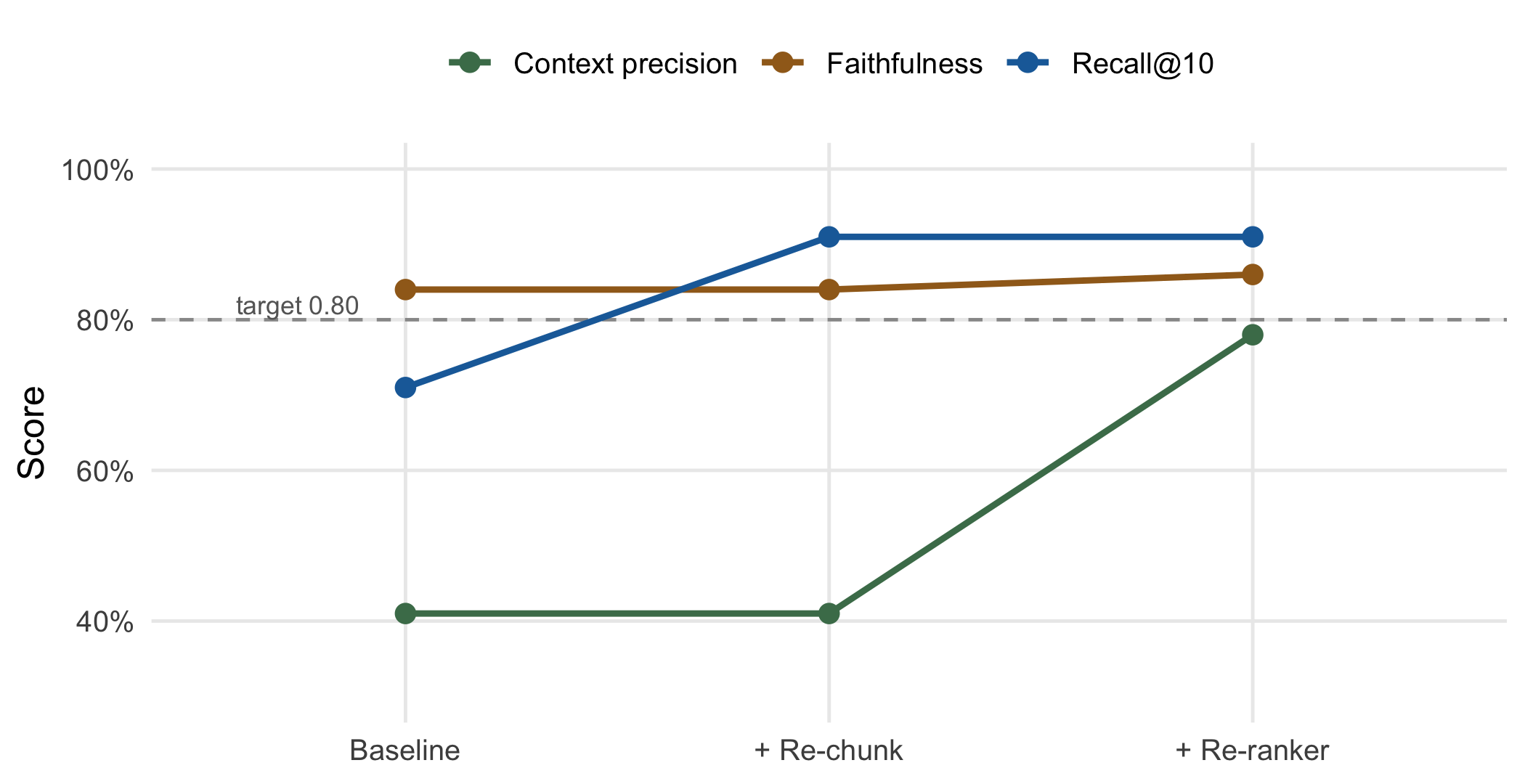
The first-pass results: Recall@10 = 0.71, faithfulness = 0.84, context precision = 0.41. The recall is below target; investigation reveals that the chunking by header section is too coarse, multi-page sections produce single chunks too large to embed well. Re-chunking with a 1,500-token cap on chunk size (preserving header context but splitting long sections) raises Recall@10 to 0.91 with no impact on the other metrics.
The second-pass results highlight a different issue: faithfulness is high but context precision is low: the model is being given more context than it needs and mostly ignoring the irrelevant parts. Adding a re-ranker (a cross-encoder model that re-scores the top-50 to produce the top-10) raises context precision to 0.78 and improves answer relevance further. The cost is about 500ms of additional latency per query, accepted.
Figure 5.2 traces the three metrics across the two tuning steps. The pattern it shows is the ordinary shape of RAG development, and worth internalising: the two interventions each moved one metric decisively while leaving the others essentially untouched. Re-chunking fixed retrieval recall; re-ranking fixed context precision; neither did the other’s job. This is why the two evaluation layers are kept separate. Had we tracked only an end-to-end answer score, we would have seen it improve twice and learned nothing about which lever did the work.
The deployed pipeline answers questions in 3–5 seconds, serves the whole research-analytics group, and is updated when new protocols are added (a nightly re-embed pipeline). The team verifies a sample of answers each week against the source documents; the failure rate is under 5% and trending down as edge cases are identified and fixed.
5.8 Collaborating with an LLM on biomedical RAG
Three prompt patterns illustrate working with LLMs on RAG-shaped problems.
Prompt 1: ‘Help me design the chunking strategy for this corpus.’ Provide a sample document and the kinds of questions the RAG should answer.
What to watch for. The LLM will recommend a default 500–1,000 token chunking with 200-token overlap and move on. For biomedical corpora, this is often wrong: the right chunking respects document structure (paper sections, guideline subsections, protocol modules). Push back: ‘show me how chunking-by-section would compare with token-based chunking on this document’.
Verification. Implement both strategies on the sample document, run the eval queries, and compare. The right chunking is empirical; the LLM’s default is a starting point, not the answer.
Prompt 2: ‘Audit this RAG output for faithfulness.’ Provide the question, the retrieved chunks, and the generated answer. Ask the model to identify claims in the answer not supported by the chunks.
What to watch for. LLMs can be reasonable faithfulness judges when given clear instructions and explicit chunks. They miss subtler unfaithfulness, a correct chunk supporting a slightly different claim than what the answer states. The LLM-as-judge approach catches gross unfaithfulness; the researcher catches the rest.
Verification. For high-stakes queries, the researcher audits manually. For routine queries, LLM-as-judge with random sampling for human verification is adequate.
Prompt 3: ‘Generate evaluation queries for this RAG.’ Provide the corpus description and the use case.
What to watch for. The LLM produces queries that sound reasonable but may be unrepresentative of actual user queries. Ask for a mix of query types: factual lookup, comparative, methodological, edge cases.
Verification. The evaluation set should be ground- truth-labeled by humans. The LLM can generate candidates, but the labels (which chunks should be retrieved, what the answer should be) require human judgment.
The meta-pattern: LLMs are useful for RAG-pipeline construction but cannot replace the empirical eval loop. A good RAG pipeline is the result of measuring recall, precision, faithfulness, and iterating on each. The LLM accelerates the iteration; the iteration itself remains the work.
5.9 Principle in use
Three habits define defensible work in this area:
Build the eval set before the pipeline. A labeled query set with expected retrieval and expected answers is the asset that makes pipeline improvements measurable. Building it after the fact is harder and biases toward the queries the pipeline already handles.
Refuse on empty retrieval. The pipeline should say ‘I don’t know’ when retrieval is empty rather than fall back on parametric knowledge. Empty retrieval is a feature, not a bug, it is the pipeline’s mechanism for telling the user the corpus does not contain the answer.
Verify citations with code. Parse the model’s citations and confirm they exist in the retrieved set. Drop or flag unverifiable citations. The check is a few lines and catches a common failure mode reliably.
5.10 Exercises
Build a small RAG pipeline (under 100 lines) over a corpus of your choice, 10–30 PDFs work as a starting point. Measure Recall@10 on 20 hand-built queries. Iterate on chunking until Recall@10 > 0.85.
Implement reciprocal-rank fusion to combine BM25 and dense retrieval. Compare the hybrid recall against each retriever alone on your eval set.
Implement a faithfulness check using LLM-as-judge. Compare its judgments against your manual judgments on 30 queries. Document the agreement rate.
Take an existing RAG pipeline and write a query that should produce ‘I don’t know’. Verify the pipeline produces it rather than fabricating an answer. If the pipeline fabricates, modify the prompt to prohibit parametric fallback.
Build a continuous evaluation harness: a script that runs your eval set nightly and produces a summary of recall, faithfulness, and answer relevance. Set up alerts for material degradation.
5.11 Further reading
- Lewis et al. (2020), Retrieval-Augmented Generation for Knowledge-Intensive NLP Tasks. The reference paper that named the architecture.
- Karpukhin et al. (2020), Dense Passage Retrieval for Open-Domain Question Answering. The dense-retrieval reference.
- Xiong et al. (2024), Benchmarking Retrieval-Augmented Generation for Medicine. Biomedical-specific RAG benchmarking with empirical guidance on retrieval choices.
- Zakka et al. (2024), Almanac: Retrieval-Augmented Language Models for Clinical Medicine. An applied case study of biomedical RAG in a clinical decision support context.
- Shahul et al. (2024), RAGAS: Automated Evaluation of Retrieval Augmented Generation. The reference RAG- evaluation framework.