flowchart TB
  R["Generative AI<br/>capability classes"] --> C["Chat<br/>fast, cheap,<br/>fluent"]
  R --> RE["Reasoning<br/>extended internal<br/>computation"]
  R --> AG["Agentic<br/>multi-step<br/>tool use"]
  R --> MM["Multimodal<br/>images, audio,<br/>documents"]
  C --> C1["Boilerplate code,<br/>drafting, lookups,<br/>survey coding"]
  RE --> RE1["Analysis planning,<br/>debugging,<br/>design review"]
  AG --> AG1["Literature screening,<br/>long-running<br/>extraction"]
  MM --> MM1["Imaging, OCR,<br/>tables from<br/>scanned reports"]
  C1 --> V["Verification proportionate to stakes<br/>(the researcher's contribution)"]
  RE1 --> V
  AG1 --> V
  MM1 --> V
2 The Generative AI Landscape for Researchers
I suppose it is tempting, if the only tool you have is a hammer, to treat everything as if it were a nail.
Abraham Maslow, The Psychology of Science (1966)
2.1 Learning objectives
By the end of this chapter you should be able to:
- Distinguish the four current capability classes of generative AI (chat, reasoning, agentic, multimodal) and select the right class for a given analytic task.
- Articulate the jagged frontier, the unevenness and opacity of AI capability, and its implications for verification in applied analytic work.
- Adopt the cybernetic teammate framing: human-AI collaboration as delegation with verification, not command-and-execute.
- Reason about cost, latency, and context-window tradeoffs in selecting models for routine versus high-stakes applied analytic work.
2.2 Orientation
A researcher in 2026 has access to four classes of generative AI capability that did not exist as a coherent toolkit five years earlier: chat models that converse fluently, reasoning models that work through problems with extended internal computation, agentic systems that take multi-step autonomous action, and multimodal models that read images, audio, and structured documents alongside text. Each class is genuinely useful and genuinely limited; none is a general substitute for researcher judgment; and the field changes faster than any textbook chapter can keep pace with.
This chapter establishes the framing the rest of the book inherits. Three concepts do most of the work: capability classes (a taxonomy that survives specific model releases), the jagged frontier (capability is uneven and opaque), and the cybernetic teammate (human-AI work is delegation, not command). The taxonomy and the framing are stable; the examples are contemporary as of writing and will date. The companion docs/mollick-digest.md and the weekly pundit-scan pipeline are the audit trail that keeps the chapter examples current.
The orientation matters because the alternative: treating generative AI as a single ‘thing’ that one either uses or does not, produces both over- and under-confident analyses. The researcher who treats every prompt as ‘asking the AI’ misses the substantial difference between asking a chat model for a code snippet, asking a reasoning model to plan a trial analysis, and asking an agent to run that analysis end to end. The discipline starts with naming what kind of collaboration is in play.
2.3 The researcher’s contribution
Before the practical taxonomy, name the judgments that are not delegable. Generative AI in 2026 is sufficiently capable that the temptation to outsource analytical decisions to it has become real and is, in specific ways, dangerous. Three judgments remain the researcher’s responsibility regardless of how capable the tooling becomes.
(Judgment 1.) Selection of the question. A model can help phrase a research question, draft an analysis plan, and produce code that addresses the plan. It cannot tell you whether the question being asked is the question that should be asked. The same dataset can support a clinically meaningful question (does treatment X reduce 30-day mortality?) and a clinically misleading one (is treatment X associated with reduced 30-day mortality controlling for severity?, where severity is a post-treatment confounder). Distinguishing the two is domain judgment, not a prompt-engineering problem. The researcher’s first contribution is to insist on the right question being asked and to push back when the AI tooling produces a clean answer to the wrong one.
(Judgment 2.) Verification proportionate to stakes. A chat model’s code output can be verified by running it. A reasoning model’s conclusion about whether a non-inferiority margin is appropriate cannot, verifying it requires statistical judgment about the clinical context. Agents that take multi-step action produce artifacts whose intermediate steps may be partially correct, partially fabricated, and partially the product of opaque internal reasoning. The researcher designs the verification regime to match the stakes: heavier verification for clinical-grade analyses, lighter verification for exploratory work, and honest acknowledgment when verification is impossible at the budget available.
(Judgment 3.) The decision about delegation itself. Generative AI is now capable enough that the right choice is sometimes ‘do not use it’. Some research questions are better answered by reading the textbook. Some pre-trial decisions are better made by talking to the principal investigator. Some quality-control checks should be done by hand, slowly, to catch what no AI is yet reliably noticing. The discipline includes saying no, and saying so explicitly in the analysis report so reviewers can understand which parts of the work were AI-assisted and which were not.
These judgments are what distinguish an analysis that survives review from one that does not. They do not diminish as AI capability grows; if anything, the more capable the tooling, the more load they bear, because the researcher’s role increasingly becomes one of adjudication rather than execution.
2.4 Capability classes: chat, reasoning, agentic, multimodal
The taxonomy that has emerged across applied-AI syllabi (Mollick, 2025a) treats current generative AI as four overlapping capability classes rather than a single product. Each class has a characteristic strength, a characteristic failure mode, and a characteristic cost profile. Figure 2.1 lays the taxonomy out before we take the classes one at a time; the detail to notice is that every branch terminates in the same node, verification, whose weight the researcher sets and no class discharges on its own.
Chat models are the most familiar form. Token-by-token text generation conditioned on a system prompt and a conversation history. ChatGPT-4o, Claude Sonnet, Gemini Flash. They are fast (responses in seconds), cheap (cents per query at the consumer tier), and broadly capable on tasks where the answer is implicit in the training distribution: drafting an email, explaining a concept, producing standard code. They are weak on novel multi-step reasoning and on tasks where the wrong-but- plausible answer is hard to detect.
For clinical and public-health researchers, chat models are the right tool for: boilerplate code generation (write me a dplyr pipeline that filters and summarizes this data), prose drafting (turn this bullet list into a methods paragraph), and quick conceptual lookups (what is the difference between ROC and PR curves). They are wrong tools for: novel analytical decisions, clinical-grade interpretation, or any task where the cost of a confident wrong answer is high.
Reasoning models add an explicit thinking phase before producing the user-visible output. The model spends extra compute generating intermediate reasoning that the user does not see, then collapses to a final answer. OpenAI’s o-series, Claude with extended thinking, Gemini 2.5, DeepSeek R1. They take longer (tens of seconds to a minute or more), cost more (an order of magnitude or more per query), and substantially outperform chat models on multi-step reasoning, mathematical problems, and complex code (DeepSeek-AI et al., 2025; OpenAI, 2024).
The trade is opacity. The thinking trace is partial or hidden, the model’s confidence in its answer is high even when the answer is wrong, and the user has fewer hooks for verification than with a chat model whose output can be inspected step by step. Reasoning models are the right tool for: planning a complex analysis, debugging a non-trivial statistical bug, evaluating whether a proposed trial design has hidden flaws. They are wrong tools for: tasks where verification matters more than depth, or where the cost of a confident wrong answer is high and verification is impractical.
Agentic models combine a reasoning model (or chat model) with the ability to take actions: browse the web, read and write files, execute code, query databases, call APIs. The model is given a goal and a set of tools and operates in a loop, choosing actions and observing their results until the goal is met or the budget is exhausted (Anthropic, 2024; Yao et al., 2023). Examples include frontier chat models with computer-use or autonomous-mode capabilities and the Model Context Protocol stack (Model Context Protocol Working Group, 2025).1
Agents are capable and dangerous. They can complete tasks that no single chat or reasoning prompt can: ‘go read these 200 papers, extract the trial design and primary endpoint from each, and produce a structured table’. They can also take incorrect action with confidence, fabricate intermediate results that are never inspected, and accumulate small errors over many steps into a final output that is wrong in ways that are hard to detect from the final output alone. Agents are the right tool when the work is long-running, the intermediate steps are independently verifiable, and the cost of a single wrong step is contained. They are wrong tools when the work is short, when verification of intermediate steps is impractical, or when the cost of silent error is high.
Multimodal models read or generate beyond text: images (clinical photographs, chest X-rays, histopathology), audio (clinical scribes, voice interfaces), video (procedural videos, ultrasound), and structured documents (PDFs with tables, EHR exports). Multimodal frontier models from major providers handle image, audio, and document inputs as a built-in capability, alongside specialized biomedical models like MedSAM (Ma et al., 2024), RETFound (Zhou et al., 2023), and BiomedCLIP (Zhang et al., 2025). The direction of travel is toward generalist medical AI, a single model spanning modalities and tasks (Moor et al., 2023), of which Med-Gemini is an early frontier-scale demonstration (Saab et al., 2024).
For clinical and public-health researchers, multimodal models are the entry point for clinical-imaging research, OCR and table extraction from clinical documents, and the AI scribe applications discussed in Chapter 7. They are limited by the same training-data biases as any other model, with the additional concern that distribution shift in imaging (different scanners, patient populations, acquisition protocols) is harder to detect than distribution shift in tabular data.
2.4.1 Capability classes in population-health work
The examples above lean clinical. The taxonomy earns its keep just as directly in population-health work, where the unit of analysis is a community rather than a patient and the recurring tasks are surveillance, evidence synthesis, and communication rather than individual diagnosis. To illustrate, consider a state health department during a winter respiratory-virus season. The syndromic-surveillance feed delivers free-text chief complaints that need coding into syndrome categories; a chat model applies the codebook at a volume no analyst team could match, and the epidemiologist double-codes a subsample to measure agreement. The weekly evidence scan for the state immunization advisory group is a screening task over hundreds of abstracts; an agent screens against pre-specified inclusion criteria, and a second reviewer audits a random sample. Planning the outbreak investigation itself, choosing the study design, anticipating confounding, is reasoning-model territory, with the epidemiologist’s judgment as the check. And the case-report forms faxed in by rural clinics arrive as scanned PDFs; a multimodal model extracts the fields, and a sample is traced back to the source pages.
Table 2.1 maps the classes to these and other recurring public-health research tasks. We suggest reading the verification column first, because that is where the analyst’s time actually goes; the class assignment is usually obvious once the task is named, but the verification design is the part that distinguishes a defensible workflow from a hopeful one.
| Public-health task | Class | Model contribution | Researcher verification |
|---|---|---|---|
| Surveillance signal triage | Chat | Codes free-text chief complaints into syndrome categories | Double-code a subsample; monitor agreement over time |
| Systematic review for evidence-based policy | Agentic | Screens abstracts against inclusion criteria; extracts study characteristics | Dual-screen a random sample; audit extracted fields |
| Open-ended survey coding | Chat | Applies a codebook to community-health-assessment responses at scale | Double-code a subsample; reconcile disagreements |
| Outbreak investigation planning | Reasoning | Works through design, confounding, and sensitivity analyses | Check against epidemiological judgment and prior investigations |
| Health communication | Chat | Drafts plain-language and translated materials for target audiences | Community review; readability checks; accuracy against current guidance |
| Environmental-exposure document review | Multimodal + agentic | Extracts monitoring values from heterogeneous scanned reports | Trace a sample of extracted values to source pages |
2.5 Model versus harness: where capability differentiation lives
The four-class taxonomy above is correct but incomplete. Treating each frontier release as a new model obscures a structural fact about the 2026 landscape: across providers, the underlying frontier models have converged in raw capability. The practical differentiation between everyday user experiences sits not in the model but in the harness around it (Raschka, 2026b).
A clean four-level decomposition makes this concrete:
- Model. The raw next-token engine.
- Reasoning model. A model trained or prompted to spend additional inference-time compute on intermediate reasoning before producing the final output.
- Agent. A control loop around a model that decides what to inspect next, which tools to call, how to update its state, and when to stop.
- Harness. The software scaffold around the agent that manages context, tool definitions, prompt caching, memory, and control flow.
The two right-hand levels (agent + harness) are where most of the apparent capability difference between, say, Claude Code and a frontier chat model in a browser actually lives. Raschka frames the implication directly: ‘A lot of apparent “model quality” is really context quality’ (Raschka, 2026b).
For the researcher, three operational consequences follow.
Read capability claims at the right level of the stack. A claim about Claude Code outperforms GPT-5 Codex often translates into a claim about the harness stack rather than the underlying model. Substituting the model in the harness can be a larger change than substituting one harness for another. The published comparison tables on provider websites usually do not isolate this.
The cost is real and rising. Agentic harnesses consume tokens at three to four orders of magnitude beyond a single chat-model query. Benedict Evans characterizes 2026 as a structural compute shortage: ‘agentic models, and especially agentic coding, have increased demand for raw capacity by orders of magnitude and the company can’t keep up’ (Evans, 2026). Provider price increases, surge pricing, capacity rationing, and shifts away from flat-rate plans are the visible manifestations. A researcher budgeting for agentic work should expect token consumption to be the dominant cost line, not seat-based licensing.
Open-weight and proprietary capability are converging on average; the differentiator is ecosystem. As of early 2026, frontier open-weight models (DeepSeek V3.2, GLM-5, Kimi K2.5, Qwen3.5) are within striking distance of the proprietary frontier on standard benchmarks (Raschka, 2026a). The remaining gap is more about the surrounding tooling (reliable APIs, code-execution sandboxes, tool catalogues, fine-tuning options, regulatory compliance attestations) than about raw model quality. For health-sciences research deployments, the practical decision is increasingly between ecosystems (Anthropic stack, OpenAI stack, Google stack, on-premises open-weight stack) rather than between models.
2.6 Closed-weight vs open-weight models
A second axis of choice, often confused with the model-vs-harness distinction, is the access regime of the underlying model. The researcher working in 2026 has, broadly, two regimes available, with a third in the background.
2.6.1 Terminology
Closed-weight models keep the trained parameters proprietary. Access is through an API or a hosted product. The user cannot download the weights, run the model locally, or fine-tune it outside the provider’s sanctioned tooling. As of mid-2026, the frontier closed-weight families are Claude (Anthropic), whose Fable 5 release of June 2026 introduced a tier above the established Opus class (Claude Opus 4.8 remains the top Opus-tier model, and a variant, Mythos 5, is released only to approved organizations); GPT-5.6 (OpenAI), previewed in late June 2026 in three tiers, Sol (flagship reasoning and long-horizon agentic work), Terra (balanced, roughly half the cost), and Luna (fastest and cheapest), initially gated to roughly twenty partner organizations at US-government request with general availability expected within weeks of this writing; Gemini 3.5 (Google), launched May 2026, with Flash generally available, Pro following shortly after, and Omni handling multimodal video generation; and Grok (xAI). The names will date quickly, as every list in this paragraph demonstrates. What is durable is the tier structure now standard within each family: a flagship reasoning tier, a balanced mid-tier, and a fast cheap tier, priced roughly an order of magnitude apart end to end.
Open-weight models publish the trained parameters under a license that lets the user download, run, fine-tune, and (often) redistribute them. Notable open-weight families include Llama 4 (Meta), a lineage whose 2023 ancestor Llama 2 established that open-weight release could coexist with a commercial strategy (Touvron et al., 2023), DeepSeek V3.x and R1 (DeepSeek), Mistral’s open releases, Qwen3.x (Alibaba), GLM-5 (Z.ai), Kimi K2.x (Moonshot), and Gemma 3 (Google). The provider may still control training-data disclosure; the licenses vary in how much they restrict commercial reuse.
Fully open-source models, the third and rarer regime, publish weights plus training code, training data, training logs, and the recipes needed to reproduce the model from scratch. Examples: OLMo (Allen AI), Pythia (EleutherAI), parts of the BLOOM project. Most of what the press calls ‘open-source AI’ is actually open-weight; the genuinely-open-source frontier is narrower and lags the capability frontier by some margin.
The shorthand commercial vs open-source is the wrong primary framing in 2026. Most open-weight models are produced commercially (Meta, DeepSeek, Alibaba, Mistral, Z.ai, Moonshot are all companies with revenue strategies that involve their open releases). Open-weight licenses can be quite restrictive: Llama’s license has acceptable-use clauses and a 700-million-MAU threshold above which a separate license is required; some ‘open’ releases (Cohere’s Tiny Aya, certain Qwen variants) are non-commercial only. Closed-weight providers offer free consumer tiers. The axis that actually matters to the researcher is whether the weights are downloadable, not whether the model is ‘commercial’.
2.6.2 Capability gap, narrowing
The 2024 capability gap between closed-weight frontier and open-weight frontier was real. The 2026 gap is, on standard benchmarks, much smaller. Raschka’s (Raschka, 2026a) February 2026 round-up of ten open-weight releases (Trinity, Kimi K2.5, Step 3.5, Qwen3-Coder-Next, GLM-5, MiniMax M2.5, Nanbeige, Qwen3.5, Ling 2.5, Tiny Aya) finds the leading open-weight models within a few percentage points of the closed-weight frontier on the major benchmarks (SWE-Bench Verified, GPQA, MMLU, MedQA). The remaining gap sits more in the ecosystem (reliable APIs, code-execution sandboxes, tool catalogues, fine-tuning attestations, regulatory compliance documentation) than in the raw model quality.
2.6.3 Tradeoffs
Table 2.2 condenses the tradeoffs. We note that for health-sciences work the first two rows, privacy and reproducibility, carry most of the decision weight; the remaining rows are conveniences that rarely override them.
| Axis | Closed-weight (API) | Open-weight (local or VPC) |
|---|---|---|
| Privacy and PHI | Data transits the provider; BAA coverage varies | Inference stays on institutional hardware |
| Reproducibility | Silent provider updates; version labels not bit-stable | Frozen weights; bit-stable across years |
| Cost structure | Per-token, linear in usage; no upfront infrastructure | Upfront GPU and operations; near-zero marginal cost |
| Capability ceiling | At or near the frontier | Within a few points; ahead in some niches |
| Ecosystem maturity | Mature SDKs, tooling, dashboards | Maturing rapidly but uneven |
| Fine-tuning | Provider-controlled tooling only | Full freedom (LoRA, QLoRA, full SFT) |
| Auditability | Opaque; behavior can change without notice | Weights, generation, and logs all inspectable |
2.6.4 A decision framework
Three regimes capture most of the choice space.
Default to closed-weight when the work is low-stakes, the data is non-sensitive, the volume is moderate, and convenience matters. Drafting methods text from a published paper, debugging an R script, exploring an analytical idea, generating boilerplate code from a data dictionary: the per-token cost is small, the verification burden is manageable, and the closed-weight ecosystem makes the work fast.
Default to open-weight on-prem (or VPC) when PHI is in scope and a vendor BAA does not adequately discharge institutional risk, when regulatory submission requires reproducibility years after inference, or when token volume crosses the cost break-even point against on-prem GPU infrastructure (typically tens of millions of tokens per month, but the calculation is institution-specific). Section Chapter 12 develops the privacy and regulatory considerations; section Chapter 13 develops the deployment mechanics.
Run a hybrid when the team’s work spans both regimes, which is increasingly the common case. Use closed-weight models for exploration, prototyping, and non-PHI drafting. Use open-weight models for production inference on PHI, for regulatory-grade reproducibility, or for any deployment where the researcher needs to guarantee that the model will respond identically next year to how it responds today.
The frame to avoid: treating “the leading model” as a fixed referent. The leading model on the researcher’s task as of early 2026 may not be the leading model six months later. Build the evaluation suite (Ch 9) so that the choice between regimes can be revisited cheaply when a new model is released.
2.7 The jagged frontier
A canonical observation about modern AI capability is that it is uneven in ways that defy ordinary intuition. The same model that produces graduate-level analysis of a complex epidemiological question fails elementary arithmetic. The same model that solves a novel coding problem cannot reliably count letters in a word. The same model that generates a publication-quality methods section invents citations to papers that do not exist. Mollick (Mollick, 2025b) names this the jagged frontier: capability rises in some directions and remains subhuman in adjacent ones, with no consistent predictor of which is which from the user’s perspective. The pattern was visible in the earliest formal capability reports for GPT-4 (Bubeck et al., 2023; OpenAI, 2023) and has not receded as models have scaled; the jagged edges move, but the jaggedness remains.
The pattern matters because it breaks two intuitive heuristics that researchers (and everyone else) naturally apply. The first is the transferability heuristic: ‘if it can do X, it can probably do Y where Y is similar to X’. The transferability heuristic fails on jagged-frontier systems. A model that successfully plans a multi-arm trial analysis may produce nonsense on a routine power calculation, because the two tasks exercise different parts of the training distribution and the user has no visibility into which.
The second failed heuristic is the confidence heuristic: ‘if it produces an answer with confidence, the answer is more likely to be right’. Generative AI systems produce all answers with confidence, including wrong answers. Hallucinated citations are not flagged. Wrong arithmetic is not flagged. Confidently incorrect analytical interpretations are not flagged. Unfortunately, calibration between expressed confidence and actual accuracy remains poor across all current systems, despite improvements at the model-card-benchmark level.
The implication for applied analytic work is direct: verification cannot be skipped, and verification cost must be budgeted from the start of any AI-assisted analysis. The jagged frontier is not a temporary problem that the next model release will fix. It is a structural property of the way these systems are trained and evaluated. New models close some jagged gaps and open others. The researcher’s protection is not to guess which gaps are open today but to design every AI-assisted workflow with verification points at the boundaries where gaps tend to land.
Three patterns of verification work across most jagged- frontier failures:
Run the code. AI-generated code that runs and produces sensible output on a known test case has passed a meaningful check. AI-generated code that has never been executed is worth less than a notepad sketch.
Cross-check against a second source. A reasoning model’s interpretation of a regulatory question can be checked against the actual regulation; a citation can be verified by looking up the paper; an analytical recommendation can be checked against a textbook. The cost of cross-checking is usually small relative to the cost of acting on a wrong answer.
Demand traceable provenance. When the model produces a substantive claim, ask it to cite the source. When the model produces a code change, ask it to explain why the change is correct. The trace is not always faithful to internal reasoning, but it gives the user a verification target that the bare output does not.
2.8 The cybernetic teammate
The third concept is a stance, not a technology. Mollick (Mollick, 2025c) reports a randomized controlled trial of 776 professionals at Procter & Gamble, randomized to alone-versus-team and AI-versus-no- AI conditions on realistic product-development workshops. The findings: AI-enabled individuals matched the performance of two-person teams without AI. Teams with AI outperformed teams without. AI eliminated the expertise silo between R&D and commercial specialists. Participants using AI reported higher positive emotion and lower anxiety.
The framing this supports is that AI-assisted work is best understood as collaboration with a teammate, not operation of a tool. A spreadsheet does what you tell it. An LLM does what you ask, plus things you did not ask, plus occasionally refuses on grounds of its own making, plus occasionally produces a partial result and asks for more information. The interaction is more like working with a junior colleague than running a script.
The shift in framing has practical implications for the researcher.
The binding skill is delegation, not prompting. Mollick (Mollick, 2026) argues the underlying skill is precise specification of deliverables, fast evaluation of output, and judicious choice of what to delegate. These are management fundamentals: clear product requirement documents, iterative feedback, recognizing when to assign and when to retain. The researcher who sees AI as a tool will write under-specified prompts and accept under-evaluated output. The researcher who sees AI as a teammate will specify deliverables, set up rapid evaluation, and maintain judgment over the work.
Domain expertise becomes more valuable, not less. In a world where compute is abundant and execution is cheap, the binding constraint shifts to knowing what to ask and recognizing when the answer is wrong. The researcher’s domain expertise, clinical-trial methodology, statistical inference, the regulatory context, is what makes good delegation possible. The AI can produce code; only the researcher knows whether the code is solving the right problem.
Adoption emerges at the edges. Mollick (Mollick, 2024) documents that the most useful AI applications come from individual practitioners discovering workflows in their own work, not from centralized IT prescription. For a research-analytics group, this means encouraging individual experimentation, sharing what works, and treating the discovery of useful patterns as part of the work rather than overhead. The runbook conventions established in Chapter 13 formalize this.
2.9 Cost, latency, and context-window tradeoffs
A practical taxonomy needs to address what each class costs and how long each takes. The constraints are not fixed (cost has fallen substantially across all classes in 2024–2026 and continues to fall), but the relative ranking is stable enough to inform routine decisions. Table 2.3 summarizes the profiles; the orders of magnitude, not the specific figures, are what to retain.
| Class | Latency | Cost / query | Context window | Best for |
|---|---|---|---|---|
| Chat | seconds | cents | 100k–500k | boilerplate, lookups, drafting |
| Reasoning | tens of seconds to minutes | tens of cents | 100k–1M | planning, debugging, hard problems |
| Agentic | minutes to hours | dollars to tens of dollars | 100k–1M with compaction | multi-step autonomous work |
| Multimodal | seconds to minutes | cents to tens of cents | 100k–1M | imaging, OCR, voice |
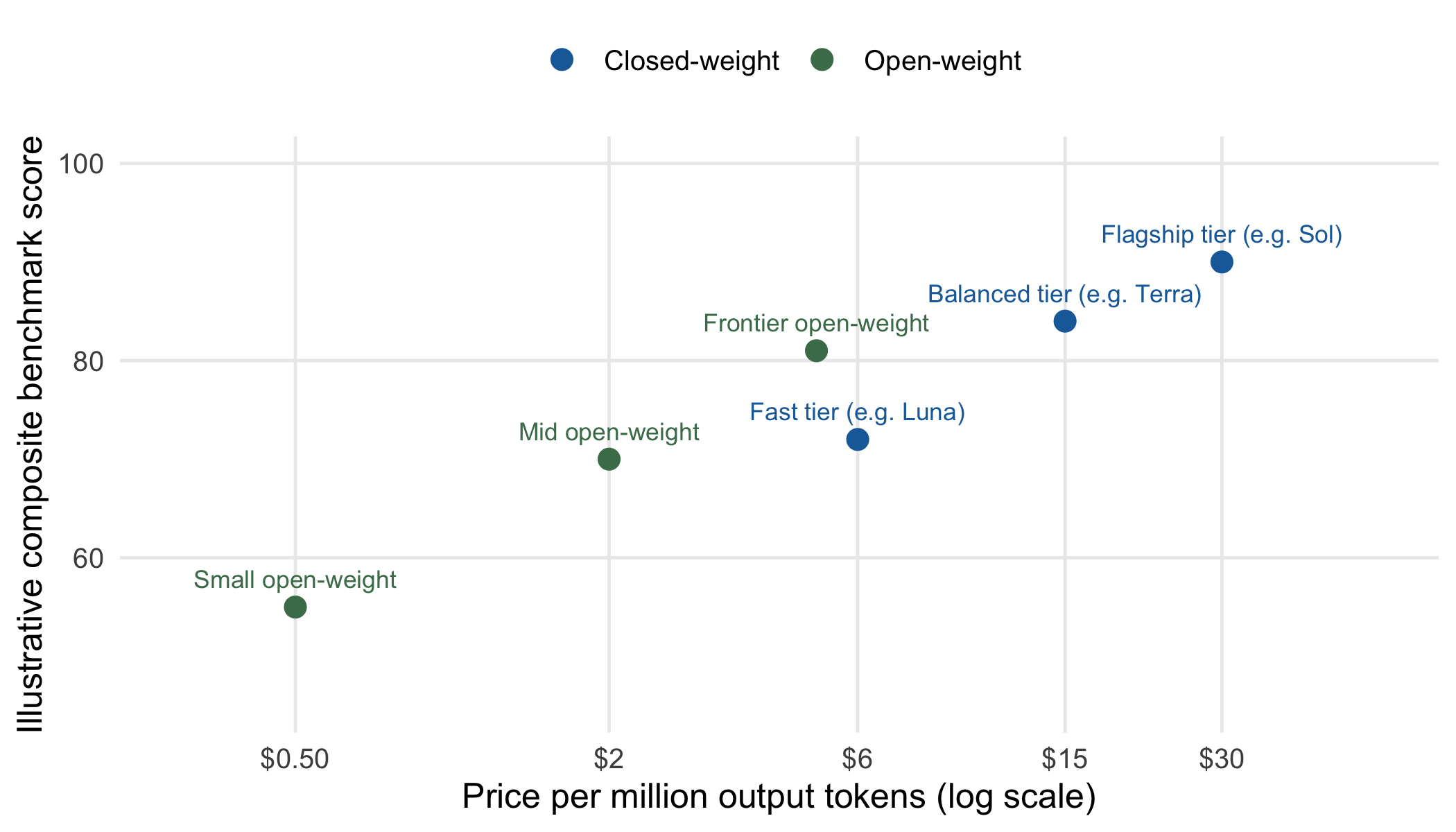
But how does capability actually scale with price? The tier structure now standard across providers gives the question concrete anchors. OpenAI’s GPT-5.6 preview prices its three tiers at roughly $30, $15, and $6 per million output tokens (Sol, Terra, and Luna respectively), a pattern echoed, with different numbers, across the other frontier families; open-weight models served on institutional hardware sit further down the price axis again. Figure 2.2 plots an illustrative composite-benchmark score against price per million output tokens for representative tiers. The shape to notice is the diminishing return at the top: the step from the fast tier to the balanced tier buys most of the capability gain, while the step from balanced to flagship costs as much again for a few further points. That does not make the flagship tier a poor purchase; for the hard problems it is the only tier that succeeds at all. It does mean the default routing for routine work should be a cheaper tier, with escalation reserved for tasks that earn it.
Two practical decision rules.
Match the model to the task, not the budget. The temptation to default to the cheapest model on cost grounds is strong and usually wrong. A reasoning model that costs ten times more per query but produces an answer that does not need to be re-asked is cheaper than a chat model that costs a tenth as much and is wrong half the time. The economics work backwards: cost-per- correct-answer is usually a better metric than cost-per- query.
Context windows are not free. A million-token context window does not mean that a million tokens of input produces high-quality output. Empirical findings suggest most current models attend strongly to the beginning and end of long contexts and weakly to the middle, an effect colloquially called ‘lost in the middle’. For applied analytic work where every detail matters (a trial protocol, a regulatory submission), the right move is usually to summarize input down to the relevant parts rather than dump the whole document. Reasoning models with extended thinking partially compensate but do not eliminate the issue.
2.10 Worked example: choosing tools for a trial-data analysis
A specific worked example fixes the framework. The trial is a multi-center randomized study of a novel diabetes medication; the primary endpoint is HbA1c change at 26 weeks; secondary endpoints include weight loss, adverse events, and patient-reported outcomes. The dataset is 3,400 patients across 18 centers. The researcher is the lead researcher; the report is for the data monitoring committee.
The work decomposes into roughly twelve sub-tasks. For each, the question is which capability class is the right tool, and where verification points need to land.
1. Drafting the statistical analysis plan. Reasoning model: the SAP needs to integrate the trial protocol, the regulatory context, and the sponsor’s pre-specified hypotheses. Chat-model output would be plausible-looking but miss subtleties. The researcher verifies by reading the protocol, the prior SAPs in the same indication, and any FDA Type C meeting minutes that inform the design.
2. Generating the analysis dataset specification. Chat model: the spec is largely boilerplate (variable names, derivations, missingness conventions). Verify by inspecting the spec against a similar prior study and by running the code it produces against the actual data.
3. Computing baseline characteristics tables. Chat model: standard tableone-style output, easy to verify. The model produces R or Python code; the researcher runs it and inspects the output for sensibility.
4. Implementing the primary efficacy analysis. Reasoning model: the primary analysis is a mixed model for repeated measures with interaction terms; the researcher needs the model to think through the fixed-effects specification, the random-effects structure, and the missing-data assumption. Verify by hand-computing the result on a small subset and comparing.
5. Sensitivity analyses. Reasoning model: a tipping- point analysis or pattern-mixture model is non-trivial and benefits from extended thinking. Verify by running the code, checking against a second implementation if available, and reading the model’s reasoning trace critically.
6. Subgroup analyses with multiplicity correction. Reasoning model: subgroup analyses are easy to get wrong in published reports. The model can plan the multiplicity correction; the researcher decides whether subgroups are pre-specified versus exploratory and ensures the report makes the distinction.
7. Adverse-event tabulation. Chat model: standard tabulation, easy to verify, no analytical judgment.
8. Patient-reported outcome scoring. Chat model: deterministic scoring rules from the questionnaire documentation. Verify by spot-checking a sample of patients.
9. Forest plots and other figures. Chat model: clean ggplot2 code, easy to verify.
10. Drafting the methods section of the report. Chat or reasoning model. Chat model produces an acceptable draft; reasoning model produces a draft that integrates nuance from the SAP. The researcher reads, edits, and is responsible for accuracy.
11. Drafting the results section. Chat model with the table and figure outputs as input. Verify by reading against the underlying numbers, the model will sometimes paraphrase a number incorrectly.
12. Cross-checking the report against the SAP. Reasoning model with both documents in context. The model can flag where the report deviates from the SAP; the researcher adjudicates whether the deviations are intentional and disclosed.
The agentic class does not appear in the workflow. For a registration-grade trial analysis, the verification overhead of agentic execution is higher than the time savings, and the regulatory expectation is that intermediate results are inspected. Agents may be appropriate for the literature search step that informs the SAP, that is the topic of Chapter 9, but not for the analysis itself.
The total cost of the AI-assisted portion of this work is roughly $20–$50 in API charges across the analysis; the researcher’s time saved is several days. The total verification overhead is roughly 30% of what the AI-assisted portion would have cost without verification, non-negligible but small relative to the time savings.
2.11 Collaborating with an LLM on the generative AI landscape
Three prompt patterns illustrate how the chapter’s concepts apply when the work itself is conducted with LLM assistance.
Prompt 1: ‘Which capability class should I use for this task?’ Provide the task description, the stakes, and the time budget.
What to watch for. The LLM will often default to recommending its own class, a chat model recommends chat-model use, a reasoning model recommends reasoning- model use. The recommendation may not reflect the genuinely right choice. The LLM also tends to under- specify the verification step; ask explicitly for the verification recommendation.
Verification. For at least the first dozen times you ask this, sanity-check the recommendation against the table earlier in this chapter. If the LLM recommends chat for a task that needs reasoning, or recommends agentic for a task with high cost-of-error, override without ceremony. The class taxonomy is small enough to internalise quickly.
Prompt 2: ‘Identify the jagged-frontier risks in this analysis plan.’ Provide the plan and ask for a list of spots where AI-assisted execution would be likely to fail silently.
What to watch for. The LLM is generally honest about its own failure modes when asked directly, but it will tend to flag generic risks (hallucination, calibration) without being specific to the analysis. Ask follow-up questions about specific calculations or judgments in the plan.
Verification. Compare the LLM’s flagged risks against your domain experience. If the LLM flagged risks you did not anticipate, take them seriously. If the LLM missed risks you anticipated, take that as evidence the LLM has gaps in this domain that affect other prompts in the same area.
Prompt 3: ‘Plan the human verification steps for an AI- assisted version of this work.’ Provide the work description and ask for a verification regime.
What to watch for. The LLM is enthusiastic about verification but tends to under-budget the time required and over-rely on automated checks (tests, type checks, linting) that do not catch the substantive errors that matter most. Ask for human-in-the-loop checkpoints specifically.
Verification. The verification regime is a contract with yourself. If you cannot afford the verification the LLM proposes, you cannot afford the work as proposed: either reduce the AI-assisted scope or accept the elevated risk explicitly.
The meta-pattern: the LLM is a useful first-pass collaborator for thinking about its own use. It is not a substitute for the researcher’s judgment about which work is appropriate to delegate. Treat its recommendations the way you would treat recommendations from a fluent intern, useful starting points, never final answers.
2.12 Principle in use
Three habits define defensible work in this area:
Name the class before you use the model. Before sending a prompt, identify which of the four capability classes you are using and why. The discipline takes seconds and prevents the most common misuse pattern (chat-model output treated as reasoning-model output, or reasoning-model speed expected from agentic work).
Budget the verification cost up front. Estimate the verification time before starting the work. If the verification is more expensive than the work, do not delegate the work. If the verification is cheaper than the work but you do not budget the time, you will skip it.
Document AI assistance in the analysis report. The methods section should disclose which classes of AI assistance were used and how their output was verified. The disclosure is part of the audit trail and is increasingly an explicit reviewer expectation for clinical and regulatory work.
2.13 Exercises
Take a recent analysis you completed without AI assistance. Decompose it into sub-tasks. For each, identify which capability class would have been the right tool and what the verification step would have been. Estimate the time savings and verification cost.
Pick a task you currently do with a chat model and try the same task with a reasoning model. Compare the output quality, the time, and the cost. Identify one task where the reasoning model is worth the premium and one where the chat model is sufficient.
Use a reasoning model to plan an analysis you do not know how to do yet. Read the model’s plan critically, identify three points where you suspect the plan is wrong, and check each. Document the plan, your suspicions, and the resolution.
Take a multimodal task in your work (a clinical image, a PDF table, an audio recording) and try solving it with a multimodal model. Compare against manual extraction. Identify the failure modes and estimate the error rate.
For a research project of your choice, draft a one-paragraph ‘AI assistance disclosure’ that would accompany the methods section. The disclosure should list classes used, verification regime, and any delegation decisions you made consciously.
2.14 Further reading
- Mollick (2025a), An Opinionated Guide to Using AI Right Now. The clearest contemporary capability-tier taxonomy, written for a general audience but precise enough for technical readers.
- Mollick (2025b), The Shape of AI: Jaggedness, Bottlenecks and Salients. The reference treatment of the jagged-frontier concept.
- Mollick (2025c), The Cybernetic Teammate. The randomized-controlled-trial evidence underwriting the teammate framing.
- Bubeck et al. (2023), Sparks of Artificial General Intelligence: Early experiments with GPT-4. The capability-mapping document that established the modern jagged-frontier vocabulary.
- Thirunavukarasu et al. (2023), Large language models in medicine. The applied-medical context for the capability classes treated here.
Specific model names current as of 2026-04 are listed in the conventions appendix; the capabilities described here will outlast specific model versions.↩︎