flowchart TB
  subgraph reason ["Reasoning model"]
    direction TB
    RI["Prompt<br/>+ context"] --> T1
    subgraph think ["Hidden thinking phase (not shown to user)"]
      direction TB
      T1["Draft<br/>steps"] --> T2["Self-check,<br/>revise"] --> T3["Converge on<br/>best guess"]
    end
    T3 --> RA["Answer:<br/>fluent, opaque"]
  end
  subgraph chat ["Chat model"]
    direction TB
    CI["Prompt<br/>+ context"] --> CA["Answer:<br/>surface-checkable"]
  end
3 Reasoning Models, Context, and the Verification Problem
The first principle is that you must not fool yourself, and you are the easiest person to fool.
Richard P. Feynman, Caltech commencement address (1974)
3.1 Learning objectives
By the end of this chapter you should be able to:
- Distinguish reasoning models from chat models and describe what extended thinking changes about both capability and verification.
- Construct context (system messages, structured outputs, few-shot examples) for biomedical tasks in a way that supports rather than obscures verification.
- Recognize when reasoning models help and when they introduce overhead without benefit.
- Apply verification patterns appropriate to opaque outputs, provisional trust, output connoisseurship, cross-check against independent computation.
3.2 Orientation
The ‘prompt engineering’ framing that dominated 2023–2024 applied-AI material does not survive the arrival of reasoning models. When the model can spend tens of seconds working through a problem internally, the user’s prompt-phrasing tricks (zero-shot vs few-shot vs chain-of- thought) matter much less than what the user puts in context, what the user asks for as output, and how the user verifies what comes back. The skill that scales is context engineering: assembling the right inputs and expected outputs so that the model has what it needs and the verification path is clear.
The chapter develops three parallel themes. What reasoning models change: extended thinking absorbs much of the chain-of-thought work that prompt-engineering guides used to teach manually, while introducing a new opacity that makes per-step inspection harder. How to construct context for biomedical work: structured inputs, structured outputs, and the small number of prompt patterns that consistently improve quality without becoming superstition. Verification under opacity: when you cannot inspect the model’s reasoning, what verification looks like, provisional trust, output connoisseurship, and independent computation as the ground truth.
The framing inherits Mollick’s Working with Wizards (Mollick, 2025) observation that competence and opacity rise together. The applied implication for applied analytic work is that the binding skill is no longer ‘how to phrase the prompt’ but ‘how to verify the output of a system whose reasoning you cannot inspect’.
The stakes of that verification skill are clearest when the output feeds a population-level decision. Consider a health department that asks a reasoning model to draft a rapid risk assessment for an emerging outbreak, or a policy brief weighing a screening program against its harms. The model returns a fluent, confidently argued document. If a single figure in it is silently wrong, the effective reproduction number computed against a stale vaccination-coverage estimate, say, the error does not announce itself; it propagates into a recommendation and from there into practice. But how does one verify a document whose reasoning one cannot inspect? That question organizes the chapter.
3.3 The researcher’s contribution
Three judgments are not delegable in this chapter’s domain.
(Judgment 1.) The decision about when to invoke reasoning. Extended thinking is not a free upgrade. It costs more, takes longer, and produces output that is opaque in characteristic ways. For routine tasks (boilerplate code, lookups, prose drafting) it is overkill; for novel multi-step problems (analytical planning, debugging hard bugs) it is the right tool. The researcher decides when the additional cost and opacity are warranted. A team that defaults to reasoning mode for everything will spend more and verify less than a team that uses reasoning selectively.
(Judgment 2.) The verification regime. Reasoning model outputs cannot be verified by the same methods that work for chat-model outputs. A chat model’s mistakes often appear as obvious surface errors (wrong syntax, contradiction with the prompt). A reasoning model’s mistakes often appear as subtly wrong conclusions that read fluently and require domain expertise to catch. The researcher designs verification regimes that match the failure mode: independent computation for analytical results, source-checking for citations, cross-model comparison for novel claims. The verification regime is not optional and is not the model’s responsibility.
(Judgment 3.) The provisional-trust contract. Some work cannot be verified end-to-end at the budget available. A 50-page literature review cannot be exhaustively fact-checked; a complex sensitivity analysis cannot be re-implemented from scratch. The researcher makes an explicit decision about how much trust to extend provisionally and documents what was verified in detail and what was sampled. The contract is with the reader of the analysis as much as with the model: ‘I verified these specific claims; I sampled these others; I take responsibility for the unsampled remainder’.
These judgments are what distinguish defensible reasoning-model use from the pattern that produces publication scandals: confident output, no verification, silent error.
3.4 What reasoning models change
Reasoning models, the lineage that runs from OpenAI’s o-series through the GPT-5.6 ‘Sol’ tier, Claude with extended thinking, Google’s Gemini 3.5, and DeepSeek R1 (Anthropic, 2025; DeepSeek-AI et al., 2025; OpenAI, 2024): add a thinking phase between input and output. The model generates intermediate tokens that are not shown to the user (or are shown in summarized form), then collapses to a final answer. The thinking phase is reinforcement- learned: models are trained to think more on harder problems and less on easier ones, with the reward signal coming from final-answer correctness on benchmarks.
Figure 3.1 contrasts the two shapes. We note that the reasoning model’s competence gain is bought with tokens the user never sees, which is precisely what makes the output harder to inspect: the visible artifact is a confident answer, and the working that produced it has been collapsed away.
The empirical effect is substantial. On novel mathematical problems, reasoning models solve problems that chat models cannot. On code generation for non- trivial algorithms, they produce working code where chat models produce plausible-looking but broken code. On multi-step analytical questions, they integrate constraints and produce defensible recommendations where chat models produce shallower answers.
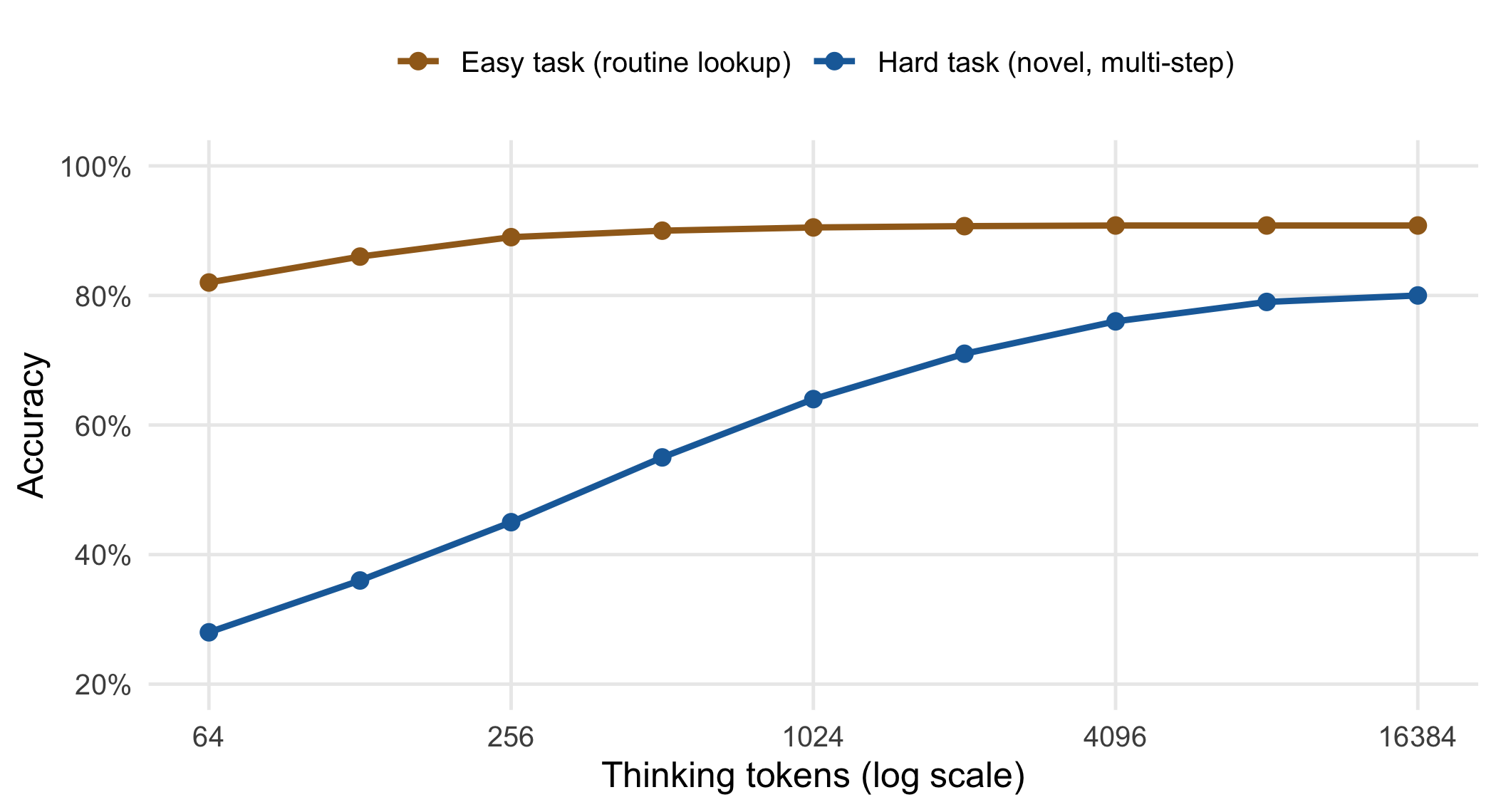
That gain, however, does not come at a constant rate. The thinking phase buys accuracy, but with diminishing returns, and the shape of the return depends on the task. Figure 3.2 illustrates the pattern that the test-time-compute literature reports: on an easy task the accuracy curve flattens quickly, so extra thinking is mostly wasted latency and cost, whereas on a hard task the curve keeps climbing well past the point where the easy task has plateaued. The practical reading is that the reasoning-model premium is worth paying in the region where the hard-task curve is still rising, and is largely wasted where the easy-task curve has gone flat.
Three changes matter for applied analytic work.
Less prompt engineering required. Mollick (Mollick, 2024a) argues that ‘good enough prompting’ is the right standard for modern systems. Elaborate few-shot examples, complex chain-of-thought templates, and prompt-engineering tricks that were load-bearing in 2023 are largely subsumed by extended thinking. The user provides context and asks the question; the model handles the reasoning internally. What used to be ‘prompt engineering’ is now context engineering: getting the right material in front of the model, not contriving the right phrasing.
Higher capability ceiling, lower verifiability floor. Reasoning models solve harder problems. They also produce output whose internal reasoning is harder to inspect. The thinking trace is partial, summarized, or hidden, depending on the model. Even when shown, the trace is not always faithful to the actual computation that produced the answer; it is closer to a post-hoc rationalization than a transparent log. The user gets a better answer with less visibility into how the answer was reached.
Calibration remains poor. Reasoning models express the same confidence on right and wrong answers. The extra compute does not produce calibrated uncertainty; it produces a single best guess at higher accuracy. For applied analytic work where uncertainty quantification is load-bearing, this is a structural limitation: do not trust expressed confidence as a signal.
3.5 Constructing context for biomedical work
Modern reasoning models have large context windows (100k–1M tokens) and good attention to in-context material when it is well-structured. The skill is arranging context so the model has what it needs without drowning the relevant bits in noise.
Four practical patterns recur across biomedical applications.
Pattern 1: Structure the input. Plain-text dumps of clinical narratives, protocol documents, or trial data work but produce noisy results. Structured input: clearly labeled sections, explicit data dictionaries, key-value summaries of relevant facts, produces better results because the model can attend to specific parts without confusing them. For a clinical question that hinges on a particular lab value, lead with the lab value labeled clearly; do not bury it in a paragraph of narrative.
PATIENT SUMMARY
- Age: 67, female
- Diagnosis: Type 2 diabetes (10y duration), CKD stage 3a
- Current HbA1c: 8.4% (target 7.0%)
- Current eGFR: 52 mL/min/1.73m^2
- Current medications: metformin 2000mg/day,
  empagliflozin 10mg/day

QUESTION
Should we add a GLP-1 agonist?

PROTOCOL CONTEXT
[paste relevant ADA guideline section here, clearly
labelled, with the recommendation and the supporting
evidence quotes]
The structured form makes verification easier, the researcher can check that the model attended to the right inputs by examining whether the output references them, and reduces hallucination by giving the model explicit material to ground in.
Pattern 2: Specify the output schema. Free-form output is fine for prose drafting; for any output that will be parsed, summarized, or compared, specify the shape. Modern models support structured-output modes (JSON schema, Pydantic, regex-constrained generation) that produce machine-readable output reliably. For a risk-of-bias assessment across 200 papers, specify the output as JSON with explicit keys for each domain rather than asking for prose summaries.
The structured-output discipline is also a verification discipline: a missing field is a flag that the model did not attend to that aspect of the question; a malformed field is a flag that the model is uncertain.
Pattern 3: Use few-shot examples for domain-specific formatting only. The chain-of-thought-via-examples pattern that was load-bearing in 2023 is mostly subsumed by extended thinking. Few-shot examples remain useful when the desired output format is unusual or domain- specific, a particular CONSORT-style table layout, a specific clinical-note phrasing convention, a custom markdown template, because the model needs to see what ‘right’ looks like for the format. Use one or two examples; more is rarely better and often worse.
Pattern 4: Ask for the reasoning trace explicitly when verification matters. Reasoning models can be asked to ‘think step by step and show your work’ or to produce the reasoning alongside the conclusion. The trace is not fully faithful to internal computation but it is a verification target. For high-stakes work, request the reasoning; spot-check whether the reasoning supports the conclusion.
You are reviewing a proposed analytical strategy for a
non-inferiority trial. Provide:
1. Your conclusion (proceed / do not proceed / proceed
   with modifications)
2. Your reasoning, in numbered steps that can be
   independently checked
3. The specific assumptions your conclusion depends on
4. The verification I should perform before accepting
   your conclusion
The fourth field is the load-bearing one: it asks the model to specify what it would have you check, which makes the verification path explicit.
3.6 Verification under opacity
Reasoning model outputs cannot be verified by the same patterns that work for chat models. Three patterns generalize across biomedical applications.
Independent computation as ground truth. Where the output is something computable, a regression coefficient, a sample size, a probability, verify by independent computation. The researcher hand-computes the result on a small example, runs a second implementation in a different language, or uses a known-good library. The goal is a separate path to the same answer; if the paths agree, the answer is probably right; if they disagree, investigate before trusting either.
Source-checking for citations and claims. Where the output cites a source, a paper, a guideline, a regulation, verify the source exists, says what the model claims it says, and is the right source for the claim. Citation hallucination remains the most common failure mode of reasoning-model output in academic contexts. The verification cost is small: open the URL, read the paragraph. Skip it at your peril.
Cross-model comparison for novel claims. Where the output is a novel claim that cannot be independently computed and is not citable, ask a second model the same question and compare. Disagreement is informative: either one model is wrong, or the question is genuinely contested in the literature. Agreement is weak evidence of correctness, both models could be wrong in the same way, but disagreement is strong evidence that further investigation is warranted.
Beyond these three, a set of named inference-time techniques operationalize verification when the answer is generated rather than looked up. Self-consistency (Wang et al., 2023) samples several independent reasoning paths for the same question and takes the majority answer; instability across the samples is itself a signal that the model is guessing rather than reasoning to a stable conclusion. Deliberate search over reasoning paths, the tree-of-thoughts pattern (Yao et al., 2023), asks the model to generate and evaluate several candidate approaches before committing to one, which surfaces the premature-commitment failures that a single trace hides. Even the elementary ‘let us think step by step’ instruction (Kojima et al., 2022) remains a way to elicit an inspectable trace, though modern reasoning models perform this step internally. For factual claims, hallucination detection and fact-checking are concrete procedures rather than aspirations: retrieve the cited passage and confirm it supports the claim (retrieval-grounded fact-checking), flag any statement the model renders with high fluency but no citable support, and treat every statistic without a traceable source as unverified until checked.
To see why this matters at population scale, consider a state health department that uses a reasoning model to draft a rapid risk assessment during a measles cluster. The model is asked whether additional vaccination clinics are warranted. It reasons through case counts, computes an effective reproduction number, and concludes that the cluster is self-limiting: no additional clinics needed. The document reads well and contains no surface error. The silent flaw is in the denominator: the model estimated the susceptible fraction from a county-level coverage figure that predates a recent decline in uptake, so its reproduction number reads just below one when the correct value is above one. Nothing in the fluent prose reveals this. Only an independent computation of the reproduction number, against the current coverage data, catches it, and the difference is the difference between a recommendation that closes the outbreak and one that lets it grow. Clearly, verification here is not an optional polish step; it is the analysis. Table 3.1 consolidates the techniques above with the failure each one detects; the reader designing a verification regime may treat the final column as a guide to which technique to reach for first.
| Technique | What it detects | How to apply | Reach for it when |
|---|---|---|---|
| Independent computation | A wrong numeric result | Re-derive by hand, run a second implementation, or use a known-good library | The output is a coefficient, sample size, probability, or rate |
| Source-checking (citation verification) | Fabricated or misattributed references | Open the source; confirm it exists and states what is claimed | The output cites a paper, guideline, or regulation |
| Cross-model comparison | Model-specific errors; genuinely contested claims | Pose the same question to a second model; investigate disagreement | The claim is novel, not computable, and not citable |
| Self-consistency (sample-and-vote) (Wang et al., 2023) | Unstable reasoning that shifts between samples | Sample several traces, take the majority answer, note the spread | A single-answer analytical question where stability is checkable |
| Deliberate path search (Yao et al., 2023) | Premature commitment to one wrong approach | Ask for several candidate approaches; evaluate before committing | Planning and design choices with several defensible routes |
| Self-critique prompting | Weaknesses the model can name but did not flag | Ask the model to identify the weakest link, then check it | A high-stakes conclusion before you rely on it |
A useful concept from Mollick is provisional trust (Mollick, 2025): the user accepts the output as a working assumption, with the understanding that material that turns out to be wrong will be corrected when found out. Provisional trust is appropriate when (a) independent verification is impractical at the budget available, (b) the cost of being wrong is bounded and recoverable, and (c) the work has downstream verification points that will catch material errors. Provisional trust is not appropriate for clinical- grade analyses, regulatory submissions, or any decision where being wrong has unrecoverable consequences.
The contract with the reader matters. A report that discloses ‘AI-assisted with verification of these specific claims and provisional acceptance of the remainder’ gives the reader a basis for adjudicating trust. A report that does not disclose AI assistance, or that implies verification was performed when it was not, is the kind of work that produces retraction notices.
3.7 When reasoning models help and when they do not
A practical decision framework: use a reasoning model when at least one of these conditions holds.
- The task requires multi-step planning where each step’s correctness depends on the others (analysis plan, trial design, debugging non-trivial code).
- The task involves a novel calculation or argument that cannot be looked up.
- The task hinges on integrating constraints from multiple sources (a protocol, a regulation, a statistical conventions document).
- The task has previously failed with a chat model and the failure was substantive rather than syntactic.
Use a chat model when all of these conditions hold.
- The task is routine in the sense that similar tasks have well-known solutions.
- The output is short enough to verify by inspection.
- The cost-of-error is bounded (re-running the task is cheap and quick).
- Latency matters (a real-time interaction, an iterative debugging loop).
Figure 3.3 renders these conditions as a single decision path. We note that every branch, whichever model it selects, ends at the same verification step: model choice changes what you verify and how, not whether you verify at all.
flowchart TD
  S["Task to run"] --> Q1{"Routine, with a<br/>well-known solution?"}
  Q1 -->|No| R["Use reasoning model"]
  Q1 -->|Yes| Q2{"Output short enough<br/>to verify by inspection?"}
  Q2 -->|No| R
  Q2 -->|Yes| Q3{"Chat model already<br/>failed substantively?"}
  Q3 -->|Yes| R
  Q3 -->|No| C["Use chat model"]
  R --> V["Design the<br/>verification regime"]
  C --> V
Table 3.2 sets the two classes side by side on the dimensions that drive the choice. The reader will see that the two rows most often overlooked are the last two: the failure mode and how it is caught differ between the classes, which is why a single verification habit does not serve both.
| Attribute | Standard (chat) model | Reasoning model |
|---|---|---|
| Latency | About a second; near-interactive | Seconds to minutes, spent in the thinking phase |
| Cost per query | Low | Several to many times higher (billed thinking tokens) |
| Best-fit tasks | Routine tasks, drafting, lookups, iterative loops | Novel multi-step problems, planning, hard debugging |
| Characteristic failure | Surface error: wrong syntax, contradiction with the prompt | Subtly wrong conclusion that reads fluently |
| How the error is caught | Surface inspection, code execution | Independent computation, source-checking, cross-model |
| Calibration | Poor | Poor; the extra compute does not fix it |
The middle ground, tasks that are not quite routine but not strictly novel, is where the choice matters most for cost and where individual experimentation pays off. Run the task with both classes occasionally; over a few months you will develop intuition for when the reasoning-model premium is worth paying.
3.8 Worked example: planning a sensitivity analysis with extended thinking
A specific worked example fixes the framework. The context: a non-inferiority trial of a new oral anticoagulant against warfarin in atrial fibrillation, with 12% missing data on the primary endpoint at the 5-year follow-up. The trial pre-specified a tipping-point sensitivity analysis but did not specify the parameter range. The researcher needs to choose the parameter range, justify it, and implement the analysis.
The chat-model attempt fails as follows. The chat model produces code for a tipping-point analysis with a default parameter range (0 to 1, in 0.05 increments). The code runs. The output is a plot showing the result tips at parameter value 0.45. The chat model does not justify the parameter range, does not anchor it to clinical plausibility, and does not address whether the tipping point at 0.45 is informative.
The reasoning-model attempt is structured differently. The researcher provides:
- The trial protocol (relevant sections only)
- The pre-specified analysis plan
- A summary of the missing-data pattern (12% missing, primarily monotone dropout, more missing in the treatment arm)
- The clinical question: ‘is the parameter range we use defensible, and what does the tipping point mean?’
The reasoning model thinks for about 90 seconds and produces a structured response:
PARAMETER RANGE RECOMMENDATION

The default 0–1 range is inappropriate for this trial.
The parameter represents the conditional event rate
among missing-treatment patients relative to observed-
treatment patients. Clinically plausible bounds:

Lower bound: 0.7 (treatment effect attenuated by 30%
among missing patients, bounded by what would happen if
half of missing patients secretly switched to control
arm)

Upper bound: 1.5 (treatment effect amplified by 50%
among missing patients, corresponds to the scenario
where missing patients are sicker and the treatment is
more effective in sicker patients; supported by the
subgroup analysis in the per-protocol set)

JUSTIFICATION

The lower bound is clinically conservative: it allows
for substantial attenuation but rules out scenarios
where the treatment is actively harmful in missing
patients (which would imply a different mechanism than
the trial population suggests).

The upper bound mirrors the subgroup-analysis-implied
interaction. Going beyond 1.5 implies the treatment
effect is more than twice as large in missing patients,
which has no basis in the observed data.

INTERPRETATION OF TIPPING POINT

If the tipping point falls inside the [0.7, 1.5] range,
the trial result is sensitive to plausible departures
from MAR; if outside, the trial is robust. The current
analysis (tipping at 0.45) is well outside the
clinically plausible range, suggesting robustness.

VERIFICATION

Cross-check the lower-bound rationale against the
pattern-mixture analysis we ran in the EU trial last
year (similar drug, similar dropout pattern). The 0.7
bound there was justified on the same logic and was
accepted by EMA in the regulatory submission.
The reasoning model’s output is not the answer; it is a proposal that the researcher evaluates. The researcher verifies:
- The parameter interpretation against the original MAR formulation in the SAP.
- The bound rationale against the EU trial document (the cross-check the model itself recommends).
- The ‘tipping at 0.45 is well outside [0.7, 1.5]’ conclusion against the actual computation.
The verification takes about 30 minutes. The researcher adopts the proposed parameter range with two adjustments (the upper bound is tightened to 1.3 to align more closely with the subgroup analysis, and the lower bound is widened to 0.6 to be conservative). The final analysis is robust within the adjusted range. The written interpretation, drafted by the model and edited by the researcher, is included in the final report with disclosure that the model assisted with parameter- range selection.
The total cost of the reasoning-model assistance: about $0.50 in API charges. The researcher’s time saved: half a day of literature review and parameter-justification drafting. The verification overhead: 30 minutes, well within budget.
3.9 Collaborating with an LLM on reasoning and context
Three prompt patterns illustrate how to use reasoning models well.
Prompt 1: ‘Plan this complex analysis and identify where I should verify your reasoning.’ Provide the analysis context (data, question, constraints) and ask for a structured plan plus verification recommendations.
What to watch for. The reasoning model will produce a detailed plan. It tends to under-specify the verification step; it will say ‘verify the result’ without specifying what ‘verify’ means. Push back: ask for specific verification steps, with expected results.
Verification. The plan is a hypothesis. Try the first step or two and confirm the model’s predictions of what you would see. If the predictions are wrong, the plan has a flaw the model did not flag.
Prompt 2: ‘Show me your reasoning trace, then critique your own conclusion.’ Ask the model to produce its reasoning explicitly and then to identify the weakest link in its own argument.
What to watch for. Reasoning models are reasonably good at self-critique when explicitly asked. They will identify weaknesses in their own arguments that they did not flag in the original answer. The self-critique is useful for the user even when the user knew the weakness already, because it makes the model’s acknowledgment of the weakness explicit.
Verification. Read the self-critique critically. Does the model identify the weakness you would identify? If yes, the model has reasonable calibration on this problem. If no, your verification needs to compensate for blind spots the model has.
Prompt 3: ‘I have a verified ground-truth answer. Walk me through how you would have arrived at it.’ Useful for calibration: pick a problem you already know the answer to, ask the model to solve it, and compare.
What to watch for. The model will sometimes produce a correct answer through a wrong reasoning path, and sometimes a wrong answer through a path that looks plausible. The reasoning trace, when faithful, is more informative than the final answer for understanding the model’s competence on this kind of problem.
Verification. Calibration prompts of this kind are worth running periodically on a few representative problems. They establish, for your specific use cases, where the model is reliable and where it is not.
The meta-pattern: reasoning models are diligent junior colleagues with extensive book knowledge but limited domain experience. They will produce careful work and can be self-critical when asked. They will not catch domain errors that domain expertise reveals. The researcher’s role is to bring the domain expertise the model lacks, not to bring the careful work the model already does.
3.10 Principle in use
Three habits define defensible work in this area:
Escalate to reasoning when chat fails twice. If a chat model produces wrong output on the same task more than once, the issue is usually the model class, not the prompt. Escalate to a reasoning model rather than continue iterating.
Verify the kind of error the model is prone to. Each model class has characteristic failure modes. Build the verification regime around those modes. For reasoning models: independent computation, source-checking, cross-model comparison. For chat models: code execution, surface inspection.
Disclose AI assistance with the verification regime. A methods section that says ‘AI-assisted’ without specifying the verification regime is inadequate. The disclosure should specify which parts of the work used AI, what verification was performed, and what was provisionally trusted.
3.11 Exercises
Take a debugging task you have struggled with. Run it with a chat model and with a reasoning model. Compare the outputs and the time. Identify what the reasoning model caught that the chat model missed.
Construct a structured-output schema (JSON) for a common task in your work, a risk-of-bias assessment, a baseline-characteristics extraction, a methods-summary table. Use it as the requested output format for several inputs and inspect the consistency.
Pick a recent claim made by a reasoning model that you accepted without verification. Verify it now. Document whether the claim was correct, partially correct, or wrong. Use the result to update your verification regime.
Run the same novel question through three different reasoning models (e.g., Claude, OpenAI o-series, Gemini). Compare the outputs. Where they agree, the answer is more likely correct; where they disagree, investigate. Document what you learn about each model’s characteristic biases.
Draft a one-paragraph ‘AI assistance and verification’ disclosure for a recent project of yours. The disclosure should specify reasoning vs chat usage, the verification regime, and the provisional-trust contract.
3.12 Further reading
- Mollick (2025), On Working with Wizards. The reference treatment of competence-and-opacity rising together.
- Mollick (2024a), Getting started with AI: Good enough prompting. The argument against elaborate prompt engineering for modern systems.
- Mollick (2024b), Thinking Like an AI. A practical mental model for token prediction, training data, and context windows.
- OpenAI (2024), OpenAI o1 System Card. The first- party document on the reasoning paradigm.
- Anthropic (2025), Claude with extended thinking. First-party documentation of Anthropic’s reasoning-model approach.
- Wei et al. (2022), Chain-of-thought prompting elicits reasoning in large language models. The technique- defining paper, useful for historical context even though much of it is now subsumed by reasoning models.