flowchart TB
  R["Researcher assigns:<br/>draft this week's<br/>situation report"] --> L
  subgraph L ["Agent loop (until draft ready or budget spent)"]
    direction TB
    A1["Act (tool call):<br/>fetch case counts<br/>from surveillance API"] --> O1["Observe:<br/>counts by county"]
    O1 --> A2["Act (tool call):<br/>read case definition<br/>and reporting lag"]
    A2 --> O2["Observe:<br/>ICD codes, lag"]
    O2 --> RE["Reason: reconcile<br/>counts vs definition"]
    RE -.->|"not yet ready"| A1
  end
  L --> H{"Epidemiologist reviews<br/>draft and flagged<br/>anomalies"}
  H -->|"request revision"| L
  H -->|"approve"| OUT["Situation report<br/>and audit trail<br/>returned to researcher"]
8 Agents, Tool Use, and the Model Context Protocol
Man is a tool-using animal. Without tools he is nothing, with tools he is all.
Thomas Carlyle, Sartor Resartus (1831)
8.1 Learning objectives
By the end of this chapter you should be able to:
- Adopt the manager mindset for agent design: precise specification of deliverables, fast evaluation, and judicious delegation, in place of step-by-step prompting.
- Wire LLMs to R, databases, and statistical software via the Model Context Protocol (MCP), with appropriate permission models and audit logging.
- Design agent loops with appropriate termination conditions, error handling, and human-in-the-loop checkpoints.
- Recognize when an agent is the right tool, when a reasoning model with tools is sufficient, and when neither is appropriate.
8.2 Orientation
An agent is a model that takes actions in a loop. Given a goal, the agent chooses an action from a set of available tools, observes the result, and decides what to do next. The loop continues until the goal is met, the budget is exhausted, or the agent gives up. The shift from chat to agent is a shift in interaction modality: instead of asking the model and reading the answer, you assign the model a task and review what it produced.
To make the loop concrete, consider a task we shall return to throughout the chapter: an agent asked to draft a weekly disease-surveillance situation report. It must pull the current case counts from a surveillance API, reconcile them against the reporting codebook (case definition, ICD codes, expected reporting lag), and draft the narrative, pausing for an epidemiologist to sign off before the report is released. Figure 8.1 traces one pass of the loop. The point to take from it is that the agent alternates between acting (a tool call) and observing (the returned result), reasoning between the two, and that a human gate sits between the drafted report and its release; nothing goes out unattested.
For clinical and public-health researchers, the agent paradigm matters because substantial chunks of applied analytic work are well-shaped for delegation: ‘fit these candidate models to the data and report which performs best on the held-out fold’, ‘reproduce the analyses in this paper using our cohort’, ‘find all the trials in our institutional database that used a stratified Cox model and summarize the stratification choices’. Each is a multi-step task with defined success criteria, the kind of work an agent can complete autonomously in the time it would take a human to start.
The chapter develops three threads. The manager mindset: how to think about delegation as a craft distinct from prompting. MCP and tool wiring: the protocol that has emerged for connecting agents to R, databases, and other systems. Agent loops in practice: designing the loop with termination conditions, error handling, and verification points so the work is trustworthy. The chapter is the most contemporary in the book; the technology stabilized in 2024–2025 and is moving fast. Pointers to current source documentation are essential.
8.3 The researcher’s contribution
Three judgments are not delegable.
(Judgment 1.) The decision about what to delegate. An agent can run an analysis, draft a report, file a ticket, send an email. The question is whether the work should be delegated. Some work, pre-trial decisions, DMC reports, regulatory submissions, should not be agent-completed regardless of capability, because the human attestation is part of the artifact’s value. The researcher decides what the agent does and what remains in human hands; the choice is a professional judgment, not a technology one.
(Judgment 2.) The specification of the deliverable. Mollick (Mollick, 2026) frames effective AI collaboration as importing management fundamentals: clear product requirement documents, iterative feedback, fast evaluation. The researcher writes the deliverable specification, what the output is, what the acceptance criteria are, what the verification points are. An under-specified delegation is the leading cause of agent runs that produce plausible-looking but wrong work.
(Judgment 3.) The verification regime. Agent output has a different failure mode than chat or reasoning- model output. Errors compound across steps; intermediate results may never be inspected; the final output may look polished while resting on broken intermediate work. The researcher designs verification points at the boundaries that matter: data ingest, model specification, key calculation, final output. Skipping these because the agent reported success is the characteristic failure mode of the era.
These judgments are what distinguish agent use that saves the researcher’s time from agent use that produces work that has to be redone, distrusted, or retracted.
8.4 The manager mindset: prompting as delegation
The shift from prompt engineering to agent management is qualitative. A chat-model prompt is a request for a deliverable in one turn. An agent assignment is a delegation that the agent will work on for minutes, hours, or days, taking actions that affect data and systems along the way.
The skills that matter shift accordingly. Mollick (Mollick, 2025, 2026) articulates the analogy precisely: effective delegation to an agent is the same skill as effective delegation to a junior colleague, with the same fundamentals.
Specification before assignment. Before kicking off an agent run, write down the deliverable as if for a human: what is being produced, what makes it acceptable, what the bounds are. Not ‘analyze the data’ but ‘fit a Cox model with these covariates, produce a forest plot of the hazard ratios with 95% CIs, and write a paragraph interpreting the result for the clinical audience’. The specification is the contract; the work either meets it or does not.
Acceptance criteria up front. What does ‘done’ look like? For an analysis: the figure exists, the numbers match independent computation, the prose is correct. For a code-writing task: the code passes the test suite, runs on a sample input. For a literature review: the cited papers exist, the summaries are accurate, the synthesis addresses the question. The criteria determine what verification looks like and prevent the ‘looks plausible’ acceptance trap.
Iterative feedback, not one-shot. Agents are best used in iterative loops: kick off, evaluate, refine the specification, kick off again. The first iteration’s output is rarely the final output. The researcher who expects one-shot success is using the tool wrong.
Choose what to delegate. Some work is well-shaped for agents (well-specified, verifiable end-to-end, contained in scope); some is not (open-ended, requires ongoing judgment, has high blast radius). The researcher’s first decision is whether to delegate at all.
The decision rule, simplified:
| Work has | Use a |
|---|---|
| Defined deliverable, verifiable output, contained scope | agent |
| Multi-step reasoning, single deliverable, no autonomous action needed | reasoning model |
| Single-turn output, surface verification | chat model |
| Open-ended judgment, unrecoverable consequences | the researcher |
8.5 The Model Context Protocol
The Model Context Protocol (MCP) (Anthropic, 2024; Model Context Protocol Working Group, 2025) is an open specification for connecting LLMs to external systems. An MCP server exposes a set of tools (functions the model can call) and resources (data the model can read) over a standardized protocol. An MCP client (the LLM application) discovers what is available and uses it.
The protocol has emerged as the de-facto standard for agent–system integration in 2025–2026. Its strengths:
- Decoupled, the same MCP server works with any MCP-compatible client (Claude desktop, Claude Code, custom applications).
- Discoverable, the server exposes its tools and schemas; the model knows what is available without hardcoding.
- Permissioned, the protocol supports per-tool permission grants, so users approve tool use rather than giving blanket access.
- Auditable, tool calls produce logs that can be reviewed.
For applied analytic work, three classes of MCP server matter.
R/Python execution servers. Run code in an isolated environment, return output and any generated artifacts. The agent can fit models, produce figures, run simulations. Care is required around environment isolation, file-system access, and resource limits.
Database servers. Execute queries against a database (typically with read-only credentials), return result sets. The agent can pull cohorts, summarize data, identify cases. The discipline that matters: the database server should expose a read-only credential, the schema the agent sees should be appropriately scoped, and the queries should be logged.
Knowledge servers. Provide access to corpora, PubMed, internal protocol libraries, institutional SOPs, via search, retrieval, or RAG-style interfaces. The biomedical RAG of Chapter 5 can be wrapped as an MCP server, making it available to any compatible agent.
A working pattern: the researcher sets up an MCP server for the team’s R environment, an MCP server for the institutional clinical database (read-only), and an MCP server for the team’s protocol library. The agent running in Claude Code or a similar client has access to all three. A request like ‘run the survival analysis for the patients in our prostate-cancer cohort using the methods from our 2023 paper’ becomes:
- Read the methods from the protocol library (MCP knowledge server).
- Pull the cohort from the database (MCP database server).
- Fit the model in R (MCP execution server).
- Return the analysis, including the figures and a summary.
An MCP server is roughly 50–200 lines of code in Python or TypeScript. The Anthropic documentation and the emerging community libraries (@modelcontextprotocol/ SDKs) make standing up a server tractable for a research-analytics team’s IT support.
A minimal R-execution MCP server skeleton (Python):
from mcp.server import Server
from mcp.types import Tool, TextContent
import subprocess

server = Server('r-execution')

@server.tool()
async def run_r_code(code: str) -> str:
    '''Execute R code and return the output.'''
    result = subprocess.run(
        ['Rscript', '-e', code],
        capture_output=True,
        text=True,
        timeout=120,
    )
    if result.returncode != 0:
        return f'ERROR: {result.stderr}'
    return result.stdout

@server.list_tools()
async def list_tools() -> list[Tool]:
    return [Tool(
        name='run_r_code',
        description='Execute R code in a sandboxed env',
        inputSchema={
            'type': 'object',
            'properties': {
                'code': {'type': 'string'},
            },
            'required': ['code'],
        },
    )]

if __name__ == '__main__':
    server.run()
The skeleton omits production concerns (sandboxing, resource limits, audit logging) but illustrates the shape. A real deployment would run the R process in a Docker container with restricted capabilities, log every call to a structured audit file, and require human approval for first-time tool calls per session.
8.6 Designing agent loops for research tasks
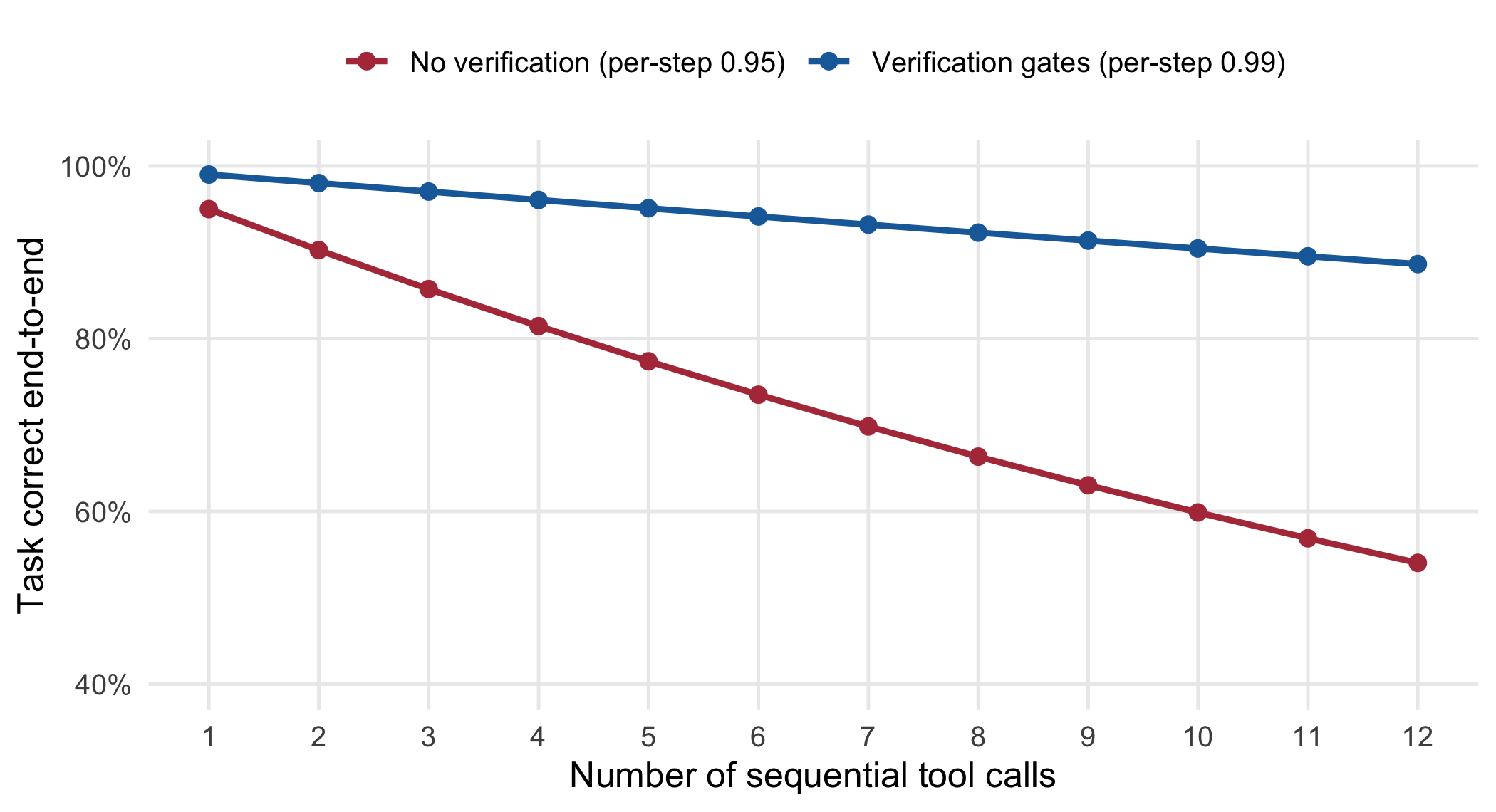
The agent loop has a small number of design decisions with outsized impact on outcomes. Before we take them in turn, it helps to see why the loop is fragile at all. Errors compound: if each step of a chain succeeds with probability \(p\), a task requiring \(n\) sequential steps succeeds with probability roughly \(p^{n}\), and \(p^{n}\) falls fast even when \(p\) is high. Figure 8.2 makes the point quantitatively. The lesson to take from it is not that agents are unreliable, but that reliability has to be manufactured step by step; a verification gate that lifts the effective per-step reliability from 0.95 to 0.99 is worth far more over a long task than the figures for a single step would suggest.
Termination conditions. The agent must know when to stop. Three patterns:
- Goal achieved. The agent has produced the deliverable and its self-check confirms acceptance criteria are met. This is the desired termination.
- Budget exhausted. The agent has used a pre-set budget (number of tool calls, wall-clock time, dollar cost) and stops with whatever progress it has made.
- Loop detected. The agent has taken the same action twice without progress. Some agent frameworks detect this; many do not.
The researcher sets the budget and the goal. A budget too small terminates the agent before completion; a budget too large runs up cost on a stuck agent. Start small, observe, expand.
Error handling. When a tool call fails, the agent sees the error and decides what to do. Sometimes the right move is to retry (transient error); sometimes it is to try a different approach (the tool does not support what was attempted); sometimes it is to abort and report (the failure indicates a structural problem). Modern agent harnesses handle the simple cases automatically; complex cases require explicit error- handling instructions in the agent’s system prompt.
Human-in-the-loop checkpoints. For high-stakes work, the agent should pause at defined points and request human review before proceeding. Examples: ‘before running the analysis, show me the cohort filter and confirm’; ‘before sending the report, confirm I should send’. The pause adds friction but prevents agent runs from cascading errors past the point where the human could catch them.
Audit trail. Every tool call should be logged with input, output, timestamp, and (where applicable) the model’s reasoning. The audit trail is the basis for post-hoc verification, debugging, and any required regulatory documentation.
We have now met the MCP primitives that expose capability to an agent and the loop-design patterns that keep the agent in bounds. Each buys something and each invites a characteristic failure. Table 8.1 consolidates them, pairing every primitive or pattern with the failure mode it invites and the guardrail that contains it; read down the guardrail column and you have, in effect, the checklist for a defensible agent deployment.
| Primitive or pattern | What it provides | Failure mode | Guardrail |
|---|---|---|---|
| Tool (MCP) | Model invokes a function (run code, query, send) | Over-broad permission; a destructive or irreversible action | Per-tool permission grant; read-only credentials; no destructive verbs |
| Resource (MCP) | Model reads data the server exposes | Stale, mis-scoped, or context-flooding data | Version and scope resources; expose only what the task needs |
| Prompt (MCP) | Reusable templated workflow the server offers | Drift from the intended use; silent template changes | Pin and review templates; treat as versioned code |
| Agent loop | Act, observe, reason, repeat | No progress; the same action taken over and over | Loop detection; require the state to change between steps |
| Termination | Stop on goal, budget, or detected loop | Premature stop, or runaway cost on a stuck agent | Start with a small budget; observe; expand deliberately |
| Human-in-the-loop | Pause at a boundary for review | Reviewer rubber-stamps; gate placed where it cannot catch harm | Gate at data ingest, key calculation, and release; make the gate consequential |
| Audit trail | Log every call, input, output, reasoning | Logs missing, or written but never read | Structured logging; scheduled post-hoc audit of a sample |
8.7 Worked example: a literature-screening agent
A research team is conducting a systematic review on a narrow biomedical question. The protocol defines inclusion criteria; the team has run a search and identified 4,200 candidate papers. Manual screening to identify the ~300 papers for full-text review will take 60–80 hours of senior reviewer time.
An agent-assisted approach:
Specification:
- Goal: identify the ~300 papers most likely to meet
  inclusion criteria for full-text review.
- Tool: PubMed-MCP server (fetch abstracts), R-MCP
  server (logging).
- Inputs: list of 4,200 PMIDs, inclusion criteria.
- Output: structured CSV with PMID, title, abstract,
  inclusion-criteria-match scores, suggested action
  (full-text-review or exclude), and a one-sentence
  rationale.
- Acceptance: 100% of papers receive an action; the
  match scores are calibrated against a 100-paper
  human-reviewed validation set with kappa > 0.7.

Loop design:
- Budget: 10,000 tool calls, ~$50 in API costs.
- Per-paper: fetch abstract, score against criteria,
  log result.
- Self-check: kappa against the validation set every
  500 papers; if it falls below 0.65, pause for human
  review.
- Termination: all 4,200 papers processed, or budget
  exhausted.

Human-in-the-loop:
- After 100 papers: human spot-check on a random 20%.
  Refine criteria interpretation if systematic errors
  found.
- After 500 papers: kappa check on validation set.
- At completion: human review of all 'full-text-
  review' papers (~300) before proceeding.
The agent runs in roughly 4 hours (rate-limited on PubMed). The output is a CSV with 4,200 rows, of which the agent flagged 287 for full-text review. The human reviewer audits the 287 + a random 100 of the excluded in 6 hours. Of the 287, 12 are excluded after audit; of the 100 excluded sample, 1 is added to full-text review. The final full-text-review count is 276, with documented agreement metrics against the agent’s recommendations.
The cost: roughly $50 in API + 6 hours of senior reviewer time, against an estimated 70 hours fully manual. The audit trail (every tool call, every score, every rationale) is preserved in the systematic-review documentation.
The published systematic review discloses the agent involvement, the validation set, the kappa, and the human-audit results. The documentation meets PRISMA requirements with the addition of an AI-tools-section.
8.8 Collaborating with an LLM on agents and tool use
Three prompt patterns illustrate working with LLMs on agent-shaped problems.
Prompt 1: ‘Design the specification for delegating this task to an agent.’ Provide the task description.
What to watch for. The LLM produces a draft specification. It tends to under-specify the verification points and over-specify the implementation details. Push back: ‘what is the verification at each step? what is the human-in-the-loop checkpoint?’
Verification. Read the specification critically. If you cannot identify the verification points, the spec is incomplete. If you cannot identify what you would do when the agent reports success, the spec is incomplete.
Prompt 2: ‘Audit this agent run.’ Provide the audit log of an agent run; ask the LLM to identify steps where verification is needed.
What to watch for. The LLM is reasonably good at identifying verification points in an after-the-fact audit. It is less good at identifying steps that should not have been allowed in the first place (the agent should not have had access to that database; the agent should have paused before that operation). The researcher brings the policy judgment.
Verification. Run the verification the LLM recommends. If issues are found, decide whether they indicate a problem with this run or a problem with the agent design that needs to be fixed before the next run.
Prompt 3: ‘Build me an MCP server that exposes this functionality.’ Provide the functionality (e.g., ‘query the institutional clinical database for cohort counts’) and the constraints (read-only, audit-logged, rate-limited).
What to watch for. The LLM produces a working server skeleton. It often omits production concerns: authentication, audit logging, error handling, resource limits. The skeleton works in development but is not production-ready. The researcher (or IT support) hardens it before deployment.
Verification. Test the server against malicious inputs (SQL injection in the query, oversized inputs, repeated calls). Verify the audit log captures all calls. Verify the credentials are scoped read-only.
The meta-pattern: agents amplify both your productivity and your blast radius. A well-specified agent run with a tight verification regime is among the highest-leverage moves the researcher can make. An under-specified agent run with weak verification is among the lowest. The difference is the discipline of specification and verification, not the technology.
8.9 Principle in use
Three habits define defensible work in this area:
Specify before delegating. A written deliverable specification with acceptance criteria precedes every agent run. The specification is the contract between the researcher and the agent; without it, the work cannot be evaluated.
Verify at the boundaries. Verification is at the data ingest, the model specification, the key calculation, and the final output. Skipping verification because the agent reported success is the characteristic failure mode.
Audit every tool call. Every agent run produces a structured audit trail of tool calls, inputs, outputs, and reasoning. The trail is the basis for any subsequent claim that the work is defensible.
8.10 Exercises
Take a routine multi-step task in your work and write a deliverable specification for delegating it to an agent. Include acceptance criteria, verification points, and human-in-the-loop checkpoints. Do not run the agent; review the spec with a colleague.
Stand up a minimal MCP server for a tool you use regularly (an R function, a database query, a file- system access). Test it with an MCP-compatible client.
Run an agent on a low-stakes task with full audit logging. After completion, audit the trail yourself. Identify steps where you would have inserted a checkpoint.
For a published systematic review or methods paper in your area, design an agent-assisted version of the work. Identify which steps could be delegated, the verification approach, and the projected savings.
Compare the cost (in API + human time) of an agent-assisted task you ran against the all-manual alternative. Document the comparison and the accuracy difference.
8.11 Further reading
- Yao et al. (2023), ReAct: Synergizing Reasoning and Acting in Language Models. The conceptual reference for agent loops.
- Schick et al. (2023), Toolformer: Language Models Can Teach Themselves to Use Tools. Adjacent: the precursor to MCP-style tool use.
- Anthropic (2024), Introducing the Model Context Protocol. The first-party announcement of MCP.
- Model Context Protocol Working Group (2025), the MCP specification document.
- Mollick (2026), Management as AI Superpower. The reference for the manager-mindset framing.
- Mollick (2025), Real AI Agents and Real Work. Applied evidence on agent capabilities for knowledge work.
- Fleming et al. (2024), MedAlign: a clinician- generated dataset for instruction following with electronic medical records. The biomedical context for instruction-following evaluation that informs agent design.